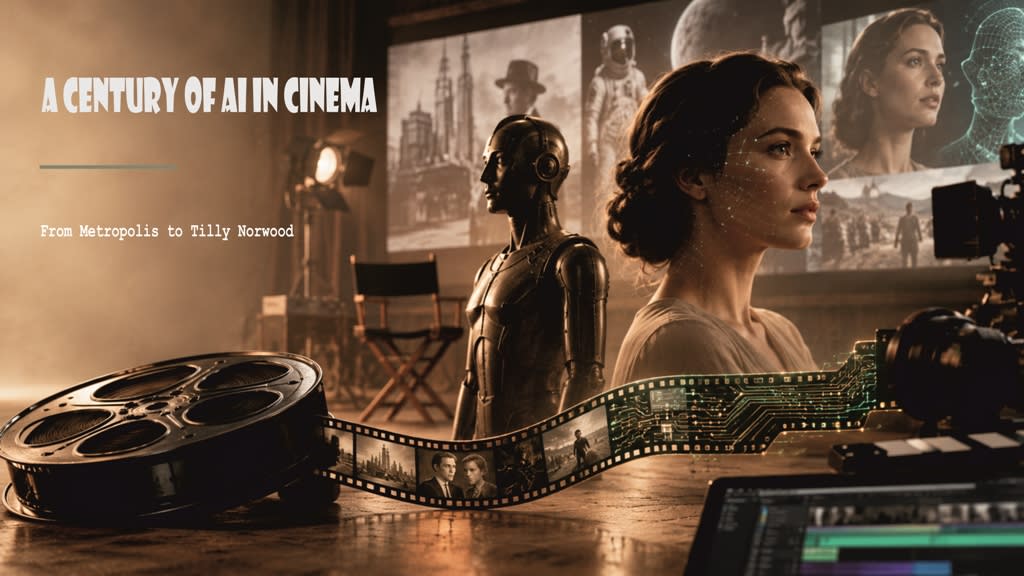
A Century of AI as a Character, Not a Tool
The first truly memorable robot on screen appeared in 1927, in Fritz Lang’s Metropolis — Maria, a humanoid machine built to manipulate and deceive. The “modern” model of fictional AI, defined by logic, autonomy, and a purpose of its own, appeared only in 1968, with HAL 9000 in 2001: A Space Odyssey, a character that influenced almost everything that followed, from Terminator to Ex Machina and Her. Dr. Paula Murphy, a researcher at Dublin City University and author of AI in the Movies (Edinburgh University Press, 2024), analyzed more than 50 films from the past 70 years and reached a simple conclusion: the context of our fears changed from one decade to the next — the Cold War, the space race, the internet — but fear of AI as a theme remained remarkably constant.
The technical side of the story evolved much more quietly. The first real forms of “AI” in film production were, in fact, basic algorithms for visual effects, used in Tron (1982) and Terminator 2 (1991), then expanded for animating crowds and creatures in The Matrix and The Lord of the Rings. One often-overlooked case is Martin Scorsese’s The Irishman (2019): the “de-aging” technology used to digitally make Robert De Niro, Al Pacino, and Joe Pesci look younger relied on machine-learning algorithms developed by Industrial Light & Magic — an early example of AI being used directly on a major production set, years before the word “generative” entered common vocabulary. Between 2000 and 2010, the first “intelligent” editing tools also appeared; software such as Adobe Premiere Pro and DaVinci Resolve began automating color correction and simple editing cuts. For two decades, AI remained an auxiliary post-production tool, invisible to the audience.
The Present: From Discreet Tool to Feature-Film Producer
What until recently was a marginal post-production tool has meanwhile become a central presence throughout the production chain. Hollywood editors already routinely use AI systems for scene stabilization, color correction, and generating rough-cut editing variants — not as a replacement, but as a tool for accelerating post-production. At Cannes 2026, Morgan Stanley analysts estimated that generative AI could reduce production costs by up to 30%, while a director attending the event — not named in press reports — said that the right tools could have cut his visual-effects budget in half (Autodesk News). Netflix has officially announced that it is going “all in” on generative AI, not to replace artists, but because, in CEO Ted Sarandos’s words, “it takes a great artist to make something great,” with AI envisioned as an efficiency tool rather than a substitute.
At the same time, at the edge of the industry, something emerged that seemed impossible two years ago: 100% AI-generated feature films being accepted into serious circuits. “Dreams of Violets,” a 75-minute docudrama directed by Ash Koosha, had its world premiere at the 2026 Tribeca Festival, the first fully AI-generated film officially accepted into the main program of a major festival, made without actors, sets, or real cameras, with a budget of just $2,000. In August 2026, AI studio Higgsfield released “The Cully Hill Boys,” a 110-minute action comedy with a $2 million budget, half of it spent on “AI tokens,” made in four weeks, using licensed AI versions of real athletes and content creators. Both projects have one thing in common: they do not come from inside the major studios, but from startups built specifically for this kind of production.
It is also worth noting what did not happen, because that says just as much about the real state of things. In December 2025, Disney announced a $1 billion agreement with OpenAI, under which more than 200 Disney, Marvel, Pixar, and Star Wars characters were to be available for use on Sora, OpenAI’s video platform. Three months later, OpenAI abruptly shut down Sora — both the app and the API — and the agreement with Disney was almost immediately canceled. I examined the economic reasons for this failure in detail in a separate article published on AIdapted.ro: in short, Sora did not fail because the technology was weak, but because operating costs estimated at between $1 million and $15 million per day could not be sustained by revenues, estimated by some sources at only around $2 million over the product’s entire lifetime. It is a useful lesson to remember: at the current pace of the market, a billion-dollar partnership and the cutting-edge technology behind it can become history in less than four months.
The Conflict: Unions, Contracts, and an Increasingly Clear Line
The tension between AI and human labor in cinema did not suddenly appear in 2026 — its roots lie in the 2023 strikes, which I covered extensively on AIdapted.ro: writers at the Writers Guild of America and actors at SAG-AFTRA effectively brought the American film industry to a standstill for months, demanding explicit guarantees that AI could not be credited as a “screenwriter” and that digital doubles of actors could not be used without paid consent. Those contracts remained the starting point for everything that followed.
In June 2026, SAG-AFTRA ratified a new TV/Theatrical Agreement, valid through 2030. The contract shows that collective bargaining can impose a clear rule for when a digital character becomes unacceptable on set, with the chosen criterion being economic rather than technical: an artificial “performer” may be used only if it provides a value that the human actor, or their already-paid digital double, cannot provide. The union is also continuing to negotiate a so-called “Tilly tax” on characters generated entirely through AI, the name coming from Tilly Norwood, a completely artificial “actress” created by Particle6 that sparked public controversy in 2025–2026. At the legislative level, the NO FAKES Act was reintroduced in the U.S. Congress in May 2026, for the fourth time in three years — a bill that would create a federal right to sue over the unauthorized use of a person’s digital likeness, supported by OpenAI, Google, and the Motion Picture Association.
The Cruise-Pitt episode described at the beginning of the article is directly connected to this thread. It was not an isolated incident: in the same week, the same tools generated viral clips featuring Anakin Skywalker, Godzilla, and even Sean Astin, the president of SAG-AFTRA, portraying a role from The Lord of the Rings without his consent. Disney accused ByteDance of effectively building a pirated library of its intellectual property, while ByteDance, under pressure, promised to “strengthen safety measures” without specifying exactly how.
The Institutional Limit: Cannes and the Oscars Draw a Line
The leadership of the Cannes Film Festival announced on April 9, 2026, that films in which generative AI forms the basis of the screenplay, image generation, or principal acting performance would become ineligible for the Official Competition and the Palme d’Or. Festival president Iris Knobloch summarized the position this way: “a film is not an assemblage of data, but a personal vision” — AI “knows how to imitate very well, but it will never know how to feel.” The rule does not, however, target every trace of AI: “technical” tools, sound restoration, image cleanup, and standard VFX applied to footage already shot by a human team remain unaffected. That is why a documentary by Steven Soderbergh, who said he used AI strictly as an “enhancement,” could still screen at Cannes 2026, although outside the main competition. What happened in parallel is also interesting: just a few streets away, the World AI Film Festival, an event dedicated exclusively to AI productions, attracted nearly 5,500 film submissions from more than 80 countries, a sign that the industry has already built, on the fly, an alternative circuit for content that major festivals are not yet allowing onto the red carpet.
Perhaps the clearest signal of where the boundaries currently stand came from the Academy of Motion Picture Arts and Sciences itself. In May 2026, the Academy announced new rules for the 99th Oscars (March 2027): only roles “demonstrably performed by humans, with their consent” would be eligible for acting awards, while screenplays must be “written by humans” to compete in the writing categories. It was a sharp change from the “neutral” position adopted just one month earlier, in April 2026, when the Academy had said that generative tools “neither help nor hurt” a film’s chances. The reason for the change was precisely the Tilly Norwood phenomenon: public pressure generated by the idea of a completely artificial “actress” forced the Academy to draw a clear line, even though AI remains permitted as a production tool as long as it is disclosed and does not entirely take over the author’s role in the relevant artistic categories. (A parenthesis that, ironically, says almost as much as the rule itself: this article cannot reproduce an image of Tilly Norwood because, although Tilly Norwood is not a real person, Particle6/XICOIA claims to own all intellectual property rights to the character. It is precisely the kind of protected content for which Disney sent cease-and-desist notices in the Seedance case discussed above. Anyone who wants to see her “face” can do so directly on her official website.)
What Comes Next: Hybridization, Not a Complete Takeover — At Least Not One Officially Recognized
Everything that has happened so far points to a pattern that is more predictable than dramatic. Major studios, Netflix, and Disney are treating AI as an efficiency multiplier under strict human control, much as they treated the arrival of digital special effects a generation ago. At the edge of the industry, startups such as Fountain 0 and Higgsfield AI are already demonstrating that a feature film can be produced with a budget in the thousands of dollars rather than millions, opening the door to stories and authors who otherwise might never have found financing. In the middle, institutions such as unions, film festivals, and the Academy of Motion Picture Arts and Sciences are trying to build, in real time, a framework that separates AI as a tool from AI that takes over the author’s role entirely.
The boundaries already taking shape are of three kinds, and none seems likely to disappear anytime soon. The first is contractual: unions have already managed to impose an economic, rather than technical, definition of the moment when a digital “performer” becomes unacceptable on set. The second is legal: disputes involving Seedance, Midjourney, or MiniMax and the question of copyright over training data are unlikely to be resolved anytime soon and will be decided in court. The third is symbolic: the Academy’s decision to explicitly exclude AI-generated roles and screenplays from its prestige categories shows that the industry is willing to separate “what can technically be done” from “what deserves artistic recognition,” a distinction that digital special effects, a generation ago, never needed to draw so explicitly.
What will not happen, at least not in the near term, is a complete and uncontested takeover. Not because the technology is incapable, but because every major step so far has been immediately followed by an institutional braking response: strikes, new contracts, legal notices, new Oscar rules. The volatility of the AI market, where a cutting-edge tool such as Sora can become history within months, just like a billion-dollar partnership, is itself a signal.
AI does not appear to be replacing the human creator in cinema; for now, it is simply forcing that creator, more and more often, to defend their place.
Sources:
· Variety (au.variety.com) — “After AI Video of 'Tom Cruise' Fighting 'Brad Pitt' Goes Viral, MPA Denounces...”
· Variety (au.variety.com) — “Paramount Sends ByteDance Cease-and-Desist Letter...”
· FilmLocal — “Hollywood Editors Embrace AI Filmmaking: A 2026 Insight”
· Autodesk News — “AI in filmmaking: What Cannes 2026 revealed...”
· TechCrunch — “Netflix goes 'all in' on generative AI...”
· Variety — “Tribeca Festival Sets First Premiere of Fully AI-Generated Film”
· Inc. — “Higgsfield AI Just Debuted the First Fully AI-Generated Feature Film”
· AIdapted — “Why Sora Failed: OpenAI’s Lesson for AI Video”
· AIdapted — “The Myth of Creativity Immune to Automation”
· SAG-AFTRA — “SAG-AFTRA Members Approve 2026 TV/Theatrical Contracts Tentative Agreement”
· Fortune — “Actors union is bargaining for 'Tilly tax' on AI film characters”
· HackerNoon — “Cannes Drew the Line on AI Films. That Same Week, 5,500 of Them Arrived in Town Anyway”
· NPR — “New Academy Rules for 99th Oscars in 2027”
· The Conversation — “What 70 years of AI on film can tell us...”
· TechCrunch — “AI-generated actors and scripts are now ineligible for Oscars”



Comments
Comments are moderated before publication.
No approved comments yet.