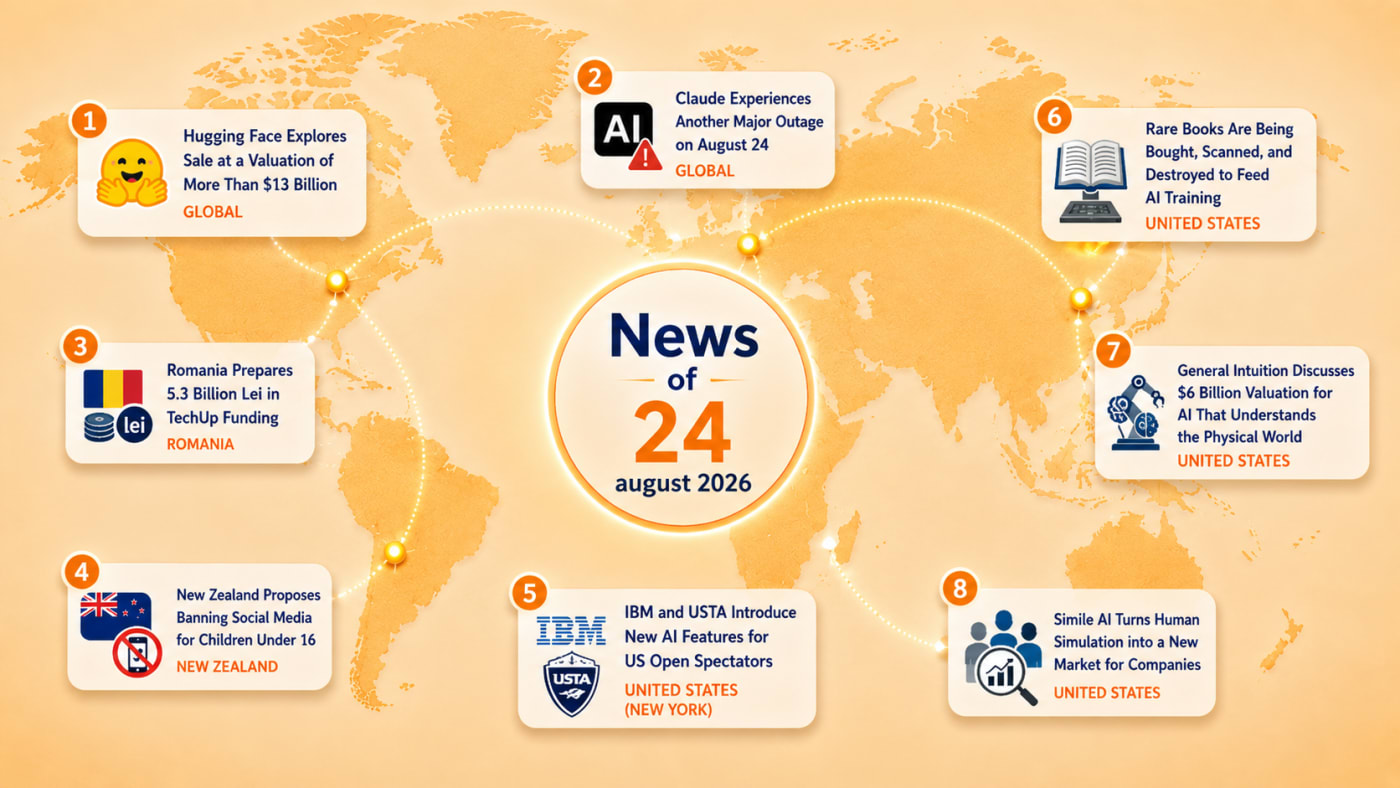
Hugging Face Explores Sale at a Valuation of More Than $13 Billion
Hugging Face, one of the most important platforms for open-source and open-weight AI models, is exploring a potential sale that could value the company at $13 billion or more, according to information published by Business Insider and reported by technology media. The company, which was valued at approximately $4.5 billion in 2023, is reportedly working with a bank to gauge interest from potential buyers. No buyer has been announced and there is currently no finalized deal.
Why it matters: Hugging Face has become de facto infrastructure for a large part of the open AI ecosystem: developers find models, datasets, and software tools there. A $13 billion valuation shows how valuable not only AI technology has become, but also the platform through which models reach millions of developers. At the same time, a potential acquisition would raise an important question: can a platform hosting models developed by competing companies remain neutral if it comes under the control of one of the major AI players?
Claude Experiences Another Major Outage on August 24
Claude services experienced another period of errors on August 24 that affected several models, including Claude Opus 5, Fable 5, and Mythos 5. Anthropic initially announced that it was investigating the problem and later said it had identified the cause and was working on a fix. According to the official status page, the incident began at 04:50 UTC and was resolved at 07:36 UTC; Anthropic reported that users were experiencing elevated error rates when making requests to the affected models.
Why it matters: An isolated outage would not be unusual for an online service, but the frequency of such incidents is becoming more relevant at a time when Claude is being used for programming, analysis, and the automation of professional processes. If AI becomes part of the infrastructure people rely on for work, its availability starts to matter as much as model performance. For companies, this may also mean the need for backup strategies involving multiple models and providers.
Romania Prepares 5.3 Billion Lei in TechUp Funding
The TechUp Romania program, approved by the government on August 20, is entering the administrative preparation stage. The scheme has an estimated budget of 5.313 billion lei for 2026–2032, financed from the state budget, and aims to connect research and development with the investment needed to turn technology into a product or service. Areas covered include artificial intelligence, advanced computing, microelectronics, autonomous systems, and cybersecurity. Eligible projects must involve investments of between 5 million and 50 million lei.
Why it matters: TechUp is attempting to address one of the structural problems facing Romania’s technology sector: the gap between laboratory research and commercial production. Companies cannot yet submit applications because the Ministry of Finance still needs to publish the program guidelines, but the mechanism has already been defined. At the same time, Romania needs an educational ecosystem capable of preparing the people who will work in these fields. In this context, the “Schools for the Future” program, analyzed by AIdapted, focuses on STEAM performance and excellence, robotics, mentoring, and students’ access to equipment and international competitions. AIdapted – “Schools for the Future”: €52.85 million for education
New Zealand Proposes Banning Social Media for Children Under 16
New Zealand Prime Minister Christopher Luxon has announced a bill that would prevent children under 16 from using social media. Platforms would have to verify users’ ages through mechanisms such as account data, digital identification, or facial age estimation, while companies that fail to comply could face fines of up to 10% of their global revenue. The proposal covers platforms such as Instagram, TikTok, Snapchat, and Facebook, but not messaging services, games, or AI productivity tools.
Why it matters: New Zealand is attempting to turn child protection from a recommendation directed at parents into a technical obligation imposed on platforms. The issue is difficult, however: age verification can involve the collection of additional data, while the effectiveness of such measures is already being challenged. Australia, which introduced a similar restriction, provides the first major test of this approach. AIdapted has already examined the difficulties Australia has faced in enforcing its under-16 social media ban. AIdapted – Australia discovers how difficult it is to keep children off social media
IBM and USTA Introduce New AI Features for US Open Spectators
IBM and the United States Tennis Association have launched new AI-powered features for the 2026 US Open that turn match data into personalized information for spectators. These include Serve Quality, an indicator that analyzes the mechanics of a serve using 21 points on the player’s body and racket, tracked 50 times per second, as well as Key Moments, which identifies moments that change the momentum of a match. Match Chat allows spectators to ask questions in natural language and receive answers based on live match data.
Why it matters: AI is no longer being presented here as a technology demonstration, but as an interface for consuming a live event. The system transforms millions of pieces of data generated during matches into explanations that spectators can understand immediately. This is an important direction for sports and media: AI is not only generating content, but is beginning to determine what information is relevant to each user and when it should be presented.
Rare Books Are Being Bought, Scanned, and Destroyed to Feed AI Training
An investigation published by The Wall Street Journal tracks the growing demand for old and rare books that end up in facilities where they are cut apart, scanned, and converted into digital data. Some of the books were traced to an Amazon facility in Las Vegas, where employees described a process involving the removal of the bindings and rapid scanning of the pages. The investigation shows that demand for high-quality printed books is being driven by AI companies’ need for material to train their models.
Why it matters: The issue goes beyond the traditional copyright dispute. For the first time, AI development is creating economic pressure on physical objects that can disappear permanently after digitization. Scanning a book can be useful for extracting its text, but destroying the original raises questions about the preservation of cultural heritage and whether the speed and cost of AI training justify the loss of the physical artifact. In the case of rare editions, the distinction between “data” and a “cultural object” becomes essential.
General Intuition Discusses $6 Billion Valuation for AI That Understands the Physical World
U.S. startup General Intuition is discussing a new funding round that could value the company at approximately $6 billion, according to TechCrunch. The company is developing a foundation model for AI agents that need to understand space and time and be able to act in the physical world. General Intuition has already raised $320 million at a $2.3 billion valuation and is expanding its work into robotics.
Why it matters: This direction is different from that of chatbots. For a robot to be useful, it is not enough for it to understand an instruction; it must understand where it is, what is happening around it, and what consequences its next action may have. The capital being raised by General Intuition shows that investors see “physical AI” as the next stage after models that operate primarily in the digital world.
Simile AI Turns Human Simulation into a New Market for Companies
Startup Simile, founded by researchers from Stanford, is developing models that create “digital twins” (AI representations of people) capable of simulating the behavior and reactions of groups of people. The company raised $100 million in Series A and subsequently another $200 million in a Series B round, reaching a valuation of approximately $2 billion. The platform is being used for market research, product testing, consumer-reaction simulations, and even anticipating questions from financial analysts.
Why it matters: Simile proposes an interesting change in the way companies can make decisions: before testing a product on real people, they can test thousands of scenarios on synthetic populations (groups of AI agents designed to reproduce certain human characteristics). The technology cannot completely replace real-world research — human behavior remains unpredictable — but it can reduce the cost and time required for initial experiments. The long-term stakes are much greater: if simulations become sufficiently accurate, they could become a new layer of infrastructure for commercial and even public decision-making.
Main Sources
- Hugging Face – information about the potential $13 billion sale
- Claude Status – August 24 incident
- Government of Romania / AGERPRES – TechUp Romania
- Reuters – New Zealand social media bill
- IBM – new AI features for the 2026 US Open
- The Wall Street Journal – books purchased for AI training
- TechCrunch – General Intuition and the $6 billion valuation
- TechCrunch – Simile funding
- AIdapted – Australia discovers how difficult it is to keep children off social media
- AIdapted – “Schools for the Future”: €52.85 million for education



Comments
Comments are moderated before publication.
No approved comments yet.