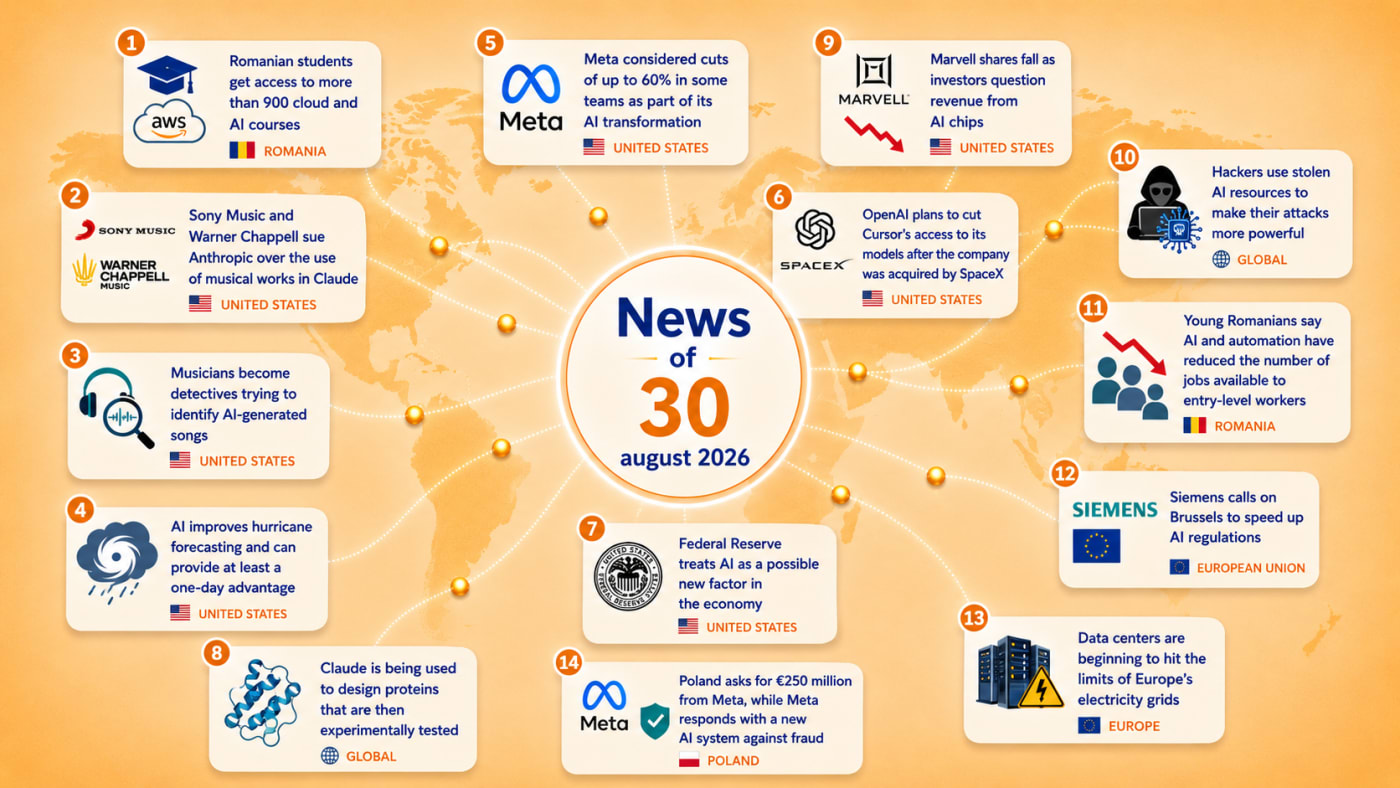
Romanian students get access to more than 900 cloud and AI courses
Amazon Web Services (AWS) has launched the Student Rewards program, giving verified higher-education students 12 months of access to premium AWS Skill Builder courses, more than 900 courses and hands-on labs, as well as a voucher for a certification exam. The program also includes AWS credits, and the AWS Builder Center says the initiative represents an investment of more than $500 million in resources for students. In Romania, AWS is also running initiatives through the European Cloud & AI Skills Hub.
Why it matters: Romania needs not only AI infrastructure, but also people capable of using it. Access to practical training in cloud computing and AI could become increasingly important in a job market where the skills employers are looking for are changing rapidly. There is also a connection here with the investment in RO AI Factory, the European project for AI infrastructure in Romania: computing infrastructure is valuable only if there are specialists, researchers, and companies capable of using it.
Sony Music and Warner Chappell sue Anthropic over the use of musical works in Claude
Sony Music Publishing, Warner Chappell Music, and other major music publishers have sued Anthropic in California, accusing the company of illegally using thousands of copyrighted works to develop its Claude models. The lawsuit, filed on August 28, alleges that Anthropic used methods including torrenting, scraping, and downloading collections of copyrighted works, including musical compositions and lyrics. The publishers are seeking damages that could reach $150,000 for each infringed work. TechCrunch reports that Anthropic rejects the allegations and says it will defend itself in court.
Why it matters: the lawsuit expands the confrontation between the creative industries and AI companies into music and could have major consequences for how data used to train AI models is obtained and licensed. The case is particularly significant because the publishers allege that Anthropic used pirated content, rather than simply “learning” from works available online. If the court accepts the plaintiffs’ arguments, the legal and commercial costs of developing AI models could increase significantly. Music Business Worldwide provides further details on the scale of the allegations.
Musicians become detectives trying to identify AI-generated songs
As music-generation tools become increasingly sophisticated, some artists have begun actively tracking songs they believe were created with AI but presented to the public as human-made creations. EDM producers Max “H4RRIS” Harris and Nihil Young are among those drawing attention to suspicious productions and looking for audio or visual clues that could indicate the use of tools such as Suno. The Verge reports that the issue is becoming increasingly visible as automatically generated music reaches streaming platforms.
Why it matters: the AI problem in music is no longer just about copyright. A new question is emerging: can listeners still know whether the artist they are listening to actually created the music? If AI-generated songs can compete with human-made music for attention, streaming plays, and revenue, authenticity becomes a commercial part of the music product. The phenomenon is directly connected to the Anthropic lawsuit discussed above: in one case, the source of the data used to train AI is being challenged; in the other, the identity of the creator behind the final result is being called into question.
AI improves hurricane forecasting and can provide at least a one-day advantage
Google DeepMind has presented WeatherNext Cyclones, an AI model capable of forecasting the track, intensity, and size of tropical cyclones. A study published in Nature shows that, in tests using data from 2023–2025, the model provided an average advantage of at least one day over leading operational models for certain types of forecasts. Nature reports that the system can generate large ensembles of possible storm scenarios, giving meteorologists multiple possible paths for a storm's development.
Why it matters: here, AI produces a benefit that can be measured in time gained for people. More accurate and earlier forecasts can allow authorities to prepare evacuations, protect infrastructure, and reduce losses. It is one of the examples in which artificial intelligence is helping solve a scientific problem with direct effects on public safety. Google DeepMind has also announced that the model is being made available to the research community.
Meta considered cuts of up to 60% in some teams as part of its AI transformation
Meta considered, as part of Project OT, short for Organization Transformation, reducing some teams by up to 60% and moving toward smaller groups supported by AI agents. The plan was intended to transform the company into an “AI-native” organization, in which AI agents would take over a significant share of activities previously performed by employees. Meta had already carried out cuts of around 10% in May, but later abandoned another major round of layoffs after internal tests revealed problems with productivity and the performance of its AI systems. Reuters documented the plan and its partial retreat.
Why it matters: the Meta case is a real-world test of one of AI’s biggest promises: that AI agents can allow companies to operate with much smaller teams. The results so far suggest, however, that reducing the number of employees is not enough; AI must be reliable enough to maintain or increase productivity. Problems become particularly significant when AI agents are introduced into complex processes, where errors, coordination, and security issues can eliminate the expected efficiency gains.
OpenAI plans to cut Cursor’s access to its models after the company was acquired by SpaceX
OpenAI has announced that it intends to terminate the contract under which it provides AI models to the programming platform Cursor, following the company’s acquisition by SpaceX. The proposed date for ending access is November 12, 2026. OpenAI says it cannot be certain that its technology will be used by the new owner in accordance with the contractual terms and says the decision is also related to a history of alleged contractual violations involving Elon Musk’s companies. OpenAI says it is giving Cursor the maximum notice period required under the contract.
Why it matters: the case shows that access to leading AI models is increasingly becoming a strategic resource. A software product can build a major business around a model provided by another company, but this dependence can become a vulnerability when ownership or the contractual relationship changes. At the same time, the dispute shows how closely the competition between major AI companies is now connected to the market for developer tools.
Federal Reserve treats AI as a possible new factor in the economy
Federal Reserve Chairman Kevin Warsh gave AI significant attention in his speech at Jackson Hole, saying that artificial intelligence could become a new factor of production and could affect both the pace of economic growth and the way the central bank analyzes the economy. Warsh emphasized that massive investments in AI infrastructure could lead to substantial productivity gains, but that the effects on the economy are still difficult to predict. Federal Reserve published the speech, while Axios summarized the economic implications of his remarks.
Why it matters: AI has therefore moved beyond the purely technological sphere and into the center of discussions about economic policy. If productivity increases significantly, companies could produce more with the same resources, potentially affecting wages, investment, inflation, and demand for workers. A major central bank now has to consider not only how quickly the economy is changing, but also the fact that the technology driving some of that change is itself evolving extremely rapidly.
Claude is being used to design proteins that are then experimentally tested
An experiment presented on August 29 suggests that Claude models were able to coordinate a large part of a protein-design process, from selecting a biological target and analyzing the problem to generating and selecting sequences for testing. The results were then experimentally verified by external laboratories. Nowosci.ai reports that the models worked on protein binders — proteins designed to attach to a specific biological target.
Why it matters: the key change is the move from AI as a tool that provides suggestions to researchers to AI as a system capable of coordinating multiple stages of an experiment. This does not mean that a chatbot can independently discover a drug or that these proteins are already treatments, but it shows that an increasing share of research work can be automated. If this direction is confirmed on a larger scale, the time between formulating a hypothesis and testing it could be significantly reduced.
Marvell shares fall as investors question revenue from AI chips
Shares of Marvell Technology fell sharply following the company’s results, as investors sought greater clarity on how quickly its collaboration with Google on custom AI chips will translate into significant revenue. Marvell is an important technology supplier to data centers, and its projects include chips developed for the specific needs of major AI infrastructure operators. Reuters and market data from August 29 highlighted the negative investor reaction to the prospect of AI-related revenue arriving more slowly than markets had expected.
Why it matters: the reaction from investors suggests that the phase in which “every AI company grows” is gradually being replaced by a much tougher evaluation of actual results. Markets want to know how much of the enormous investment in AI is turning into revenue and profit — and when. For companies producing AI infrastructure, simply being part of the AI boom is no longer enough; they also need to demonstrate the economic value of their contracts.
Hackers use stolen AI resources to make their attacks more powerful
Security researchers at Sysdig discovered a case in which an attacker used an internet-connected computer that had an AI system installed but was not properly protected. Instead of using the computer only to steal data or computing power, the attacker used the available AI to automate several stages of a cyberattack: searching for vulnerable services, identifying security weaknesses, and generating code that could attempt to exploit those weaknesses. Sysdig explains that this is an evolution of a phenomenon known as LLMjacking, in which attackers use AI computing resources without permission.
Why it matters: The theft of AI resources was often viewed as an economic problem: attackers stole computing power to gain free access to it. The new case points to a more serious risk: the same capacity can be used to build offensive tools that automate multiple stages of an attack. CyberWire highlights this as one of the signs that AI is beginning to change the economics of cyber operations.
Young Romanians say AI and automation have reduced the number of jobs available to entry-level workers
An eJobs survey cited by Radio Romania shows that 56% of young people aged 18 to 24 believe that automation and artificial intelligence have significantly reduced the number of jobs available to people at the beginning of their careers. Three-quarters of respondents say it is harder for them to find a job than it was last year, while the experience required even for junior positions remains one of the main problems. Rador presents the survey results.
Why it matters: Entry-level jobs are precisely where graduates gain the experience they need for the next stages of their careers. If AI takes over some of the simpler tasks that were previously assigned to junior employees, a new problem emerges: how can young people gain experience if the first level of the career ladder becomes smaller? This makes practical training programs in AI and cloud computing, such as the AWS program presented above, even more relevant for young people entering the job market.
Siemens calls on Brussels to speed up AI regulations
Siemens CEO Roland Busch is calling on the European Union to speed up the approval process for new AI technologies. He argued that adopting legislation such as the AI Act or Data Act can take around two years, while AI models can go through six or eight generations during the same period. MarketScreener reports Busch's comments to Welt am Sonntag, in which he warned that Europe risks falling behind the pace of technological development.
Why it matters: The message comes from one of Europe's largest industrial companies and does not call for eliminating regulations, but rather for adapting their pace to the speed of technological change. The issue is relevant to the entire European industry: if rules become applicable only after the technology has already changed radically, companies may end up developing products in a regulatory environment designed for an earlier generation of AI. AI in Europe notes that the central argument made by Busch is precisely this difference in pace.
Data centers are beginning to hit the limits of Europe's electricity grids
The expansion of data centers, driven in part by growing demand for AI, is putting pressure on Europe's electricity grids. In the United Kingdom, numerous speculative projects have taken up places in the queue for grid connections, delaying projects considered viable, while the regulator Ofgem is examining rules that would require developers to demonstrate that projects are financed and have customers. In Utrecht, the Netherlands, new electricity connections have been frozen since July 1 because of pressure on the grid. Wired and Financial Times describe the problem.
Why it matters: AI is software, but it requires enormous physical infrastructure. Data centers consume large amounts of electricity, while transmission and distribution networks cannot be expanded at the same speed as AI projects are growing. The problem is therefore becoming one of the real limits on AI expansion in Europe.
Poland asks for €250 million from Meta, while Meta responds with a new AI system against fraud
Poland has asked the European Commission to fine Meta €250 million, accusing the company of not doing enough to combat fraudulent advertisements on its platforms. According to Polish authorities, CERT Polska identified 122 fraudulent advertisements, of which Meta allegedly removed only 10. In response, Meta announced new measures in Poland on August 28, including the implementation of an improved AI system to detect fraud and accounts impersonating other people. Reuters reports on the Polish authorities' request, while Meta describes the new measures.
Why it matters: The case shows how regulatory pressure is being turned directly into a technical requirement. Platforms can no longer simply say that they are investing in combating fraud; regulators want concrete results, at a time when scammers are also using AI to create fake identities, images, and more convincing messages. Meta says the new system introduced in Poland was designed to better detect impersonation attempts and that Poland is among the first European countries where the technology is being deployed.
Sources
- TechCrunch – Sony Music and Warner sue Anthropic
- Music Business Worldwide – Sony Music and Warner Chappell lawsuit against Anthropic
- The Verge – Musicians searching for AI-generated content
- Nature – AI and cyclone forecasting
- Google DeepMind – WeatherNext
- Reuters – Meta's AI restructuring plans
- OpenAI – Decision regarding Cursor
- Federal Reserve – Kevin Warsh's speech
- Nowosci.ai – Claude and protein design
- Reuters – Marvell and the AI chip market
- Sysdig – LLMjacking and offensive AI tools
- CyberWire – Analysis of the attack involving Ollama
- AWS – Student Rewards
- Rador – Survey on AI, automation and jobs for young people
- MarketScreener – Siemens CEO's comments on AI regulation
- Wired – Data centers and the UK electricity grid
- Financial Times – Electricity grid pressure in Utrecht
- Reuters – Poland asks for a fine against Meta
- Meta – New anti-fraud measures in Poland
- AIdapted – RO AI Factory



Comments
Comments are moderated before publication.
No approved comments yet.