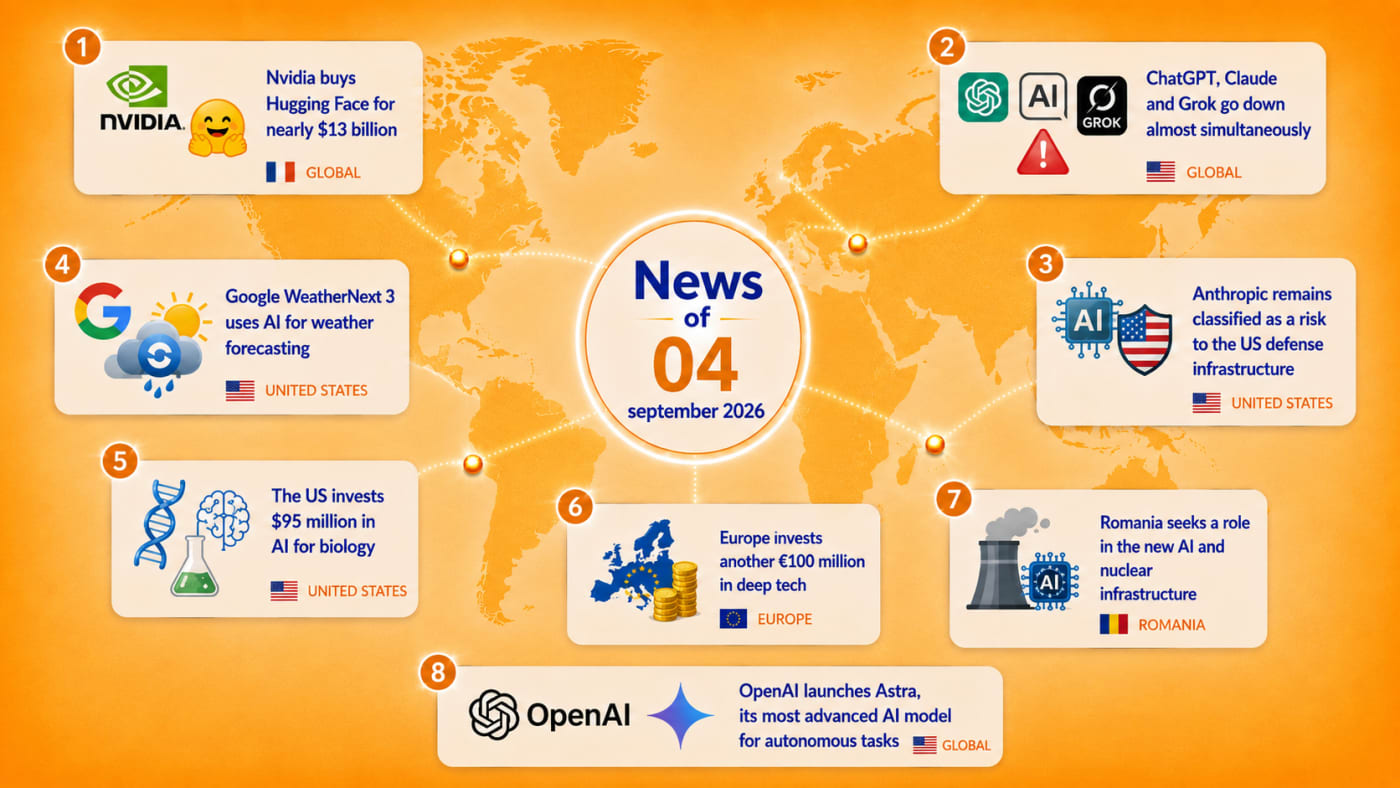
OpenAI launches Astra, its new flagship AI model
OpenAI launched Astra, its new artificial intelligence model, on Thursday, September 3, presenting it as the company’s most capable model to date. Astra is designed to autonomously perform complex tasks on computers and in browsers, and OpenAI says it can carry out professional activities with significantly improved speed and accuracy. A preview of the model was conducted by the AIdapted editorial team in an analysis published on September 2.
Why it matters: Astra marks another step toward AI agents capable of working with a high degree of autonomy, including in areas such as programming, document analysis, and cybersecurity. OpenAI says the model has reached its “critical capabilities” threshold in cybersecurity for the first time, allowing it to identify previously unknown vulnerabilities and develop exploitation methods without human guidance at every step. The launch therefore comes with additional safeguards and limited access to the most advanced capabilities.
Nvidia buys Hugging Face for nearly $13 billion
Nvidia has announced the acquisition of Hugging Face for $12.93 billion, in one of the most significant deals in the AI industry. Hugging Face is one of the leading platforms for open-source and open-weight AI models, providing models, datasets and tools to millions of developers. Nvidia says the platform will remain open and that users will continue to be able to work with models and infrastructure from different providers. Reuters
Why it matters: The acquisition shows that Nvidia is expanding far beyond the processors powering AI data centers. The company is moving deeper into software, models and developer ecosystems — precisely the areas where the next layer of the AI industry is being built. For Hugging Face, the deal is equally significant: the platform is becoming part of the world's most valuable AI infrastructure company, while Nvidia says it intends to preserve the openness of the ecosystem.
ChatGPT, Claude and Grok go down almost simultaneously
On September 3, ChatGPT, Claude and Grok experienced service disruptions within a similar timeframe. Users reported errors and access problems, while several ChatGPT functions were affected. Claude also experienced problems involving Claude Code and its API, while Grok was unavailable for some users. There is currently no confirmation that the three incidents shared the same underlying cause. The Verge
Why it matters: The outages highlight the growing importance of AI reliability at a time when chatbots are becoming working infrastructure for millions of people and businesses. As AI usage grows, the infrastructure behind these services becomes critical.
Anthropic remains classified as a risk to the US defense infrastructure
Anthropic is still considered a “Supply Chain Risk” by the US Department of Defense and the defense industrial base, according to a senior US official. The statement came after Commerce Secretary Howard Lutnick suggested a day earlier that relations between the Trump administration and Anthropic had improved. The situation remains complicated following a federal judge's ruling that the Pentagon's designation of Anthropic as a supply-chain risk was unlawful. Reuters
Why it matters: The case shows how AI has become a national-security issue. For the US government, the question is no longer simply how capable an AI model is, but whether it can be safely deployed across military infrastructure without its supplier becoming a strategic risk. For Anthropic, the dispute could affect access to government contracts and its relationship with one of the world's most important markets for advanced AI.
Google WeatherNext 3 uses AI for weather forecasting
Google DeepMind and Google Research have launched WeatherNext 3, described as the company's most advanced AI weather forecasting model. It uses real-time satellite observations, updates forecasts hourly and can generate predictions at resolutions of up to 5 kilometers. WeatherNext 3 will power products including Google Search, Maps and Gemini, and is also available to developers through Google Cloud. Google DeepMind – WeatherNext 3
Why it matters: Weather forecasting is a particularly concrete example of AI transforming a scientific problem into a service with direct effects on people and the economy. More accurate forecasts can benefit agriculture, transportation, energy production and preparation for extreme weather. The combination of hourly updates and real-time satellite data also points to an important trend: specialized AI models are becoming increasingly connected to real-world data.
The US invests $95 million in AI for biology
The University of Washington, Allen Institute and Fred Hutch Cancer Center have launched an initiative worth approximately $95 million to advance AI in biology. Called AI BioDesign, the project aims to build models, datasets and tools that allow researchers to use AI to design new biological tools inspired by the way nature constructs molecules and complex systems. GeekWire – AI BioDesign
Why it matters: AI is moving from analyzing existing biological information toward designing new biological solutions. Models can help identify and prioritize proteins or molecules worth testing experimentally, potentially reducing the number of experiments required. If this approach scales successfully, the combination of AI and biology could accelerate research in medicine, biotechnology and the development of new therapies.
Europe invests another €100 million in deep tech
Uplift Ventures has launched a €100 million fund for European deep-tech startups. Backed by German industrial group Jungheinrich, the fund will invest in early-stage companies working in areas including Physical AI, energy, Enterprise AI and logistics. Investments will focus primarily on Europe, although the fund can also support international projects. EU-Startups – Uplift Ventures
Why it matters: The investment shows that Europe is trying to finance not only AI software applications, but also the physical technologies and infrastructure that will support the next stage of the industry. Physical AI, energy and logistics are areas where AI directly intersects with the real economy. For Europe, the challenge is to avoid becoming merely a consumer market for technologies developed in the US and China and instead build its own companies and infrastructure.
Romania seeks a role in the new AI and nuclear infrastructure
Following the same infrastructure logic, Romania is trying to establish a position in the emerging AI economy by combining computing capacity with energy infrastructure. In a report published on September 3, TVR examined Romania's AI projects and the prospect of large-scale infrastructure supported by nuclear power. The report discusses the development of two AI “factories” and presents a project estimated at approximately $5 billion, linked to AI infrastructure and nuclear energy. TVR – Romania, AI and nuclear infrastructure
Why it matters: For Romania, the goal is not simply to buy and use AI services, but to build part of the infrastructure that makes them possible. AI data centers require enormous amounts of electricity, making their expansion increasingly dependent on energy availability and grid capacity. In this context, combining high-performance computing infrastructure with nuclear power could become a strategic advantage — provided the announced projects are ultimately turned into operational capacity.
Sources
- Reuters – Nvidia buys Hugging Face
- The Verge – ChatGPT, Claude and Grok outages
- Reuters – Anthropic remains a defense supply-chain risk
- Google DeepMind – WeatherNext 3
- GeekWire – AI BioDesign
- EU-Startups – Uplift Ventures fund
- TVR – Romania, AI and nuclear infrastructure
- AIdapted – Anthropic and Claude Code
- AIdapted -OpenAI launched Astra


Comments
Comments are moderated before publication.
No approved comments yet.