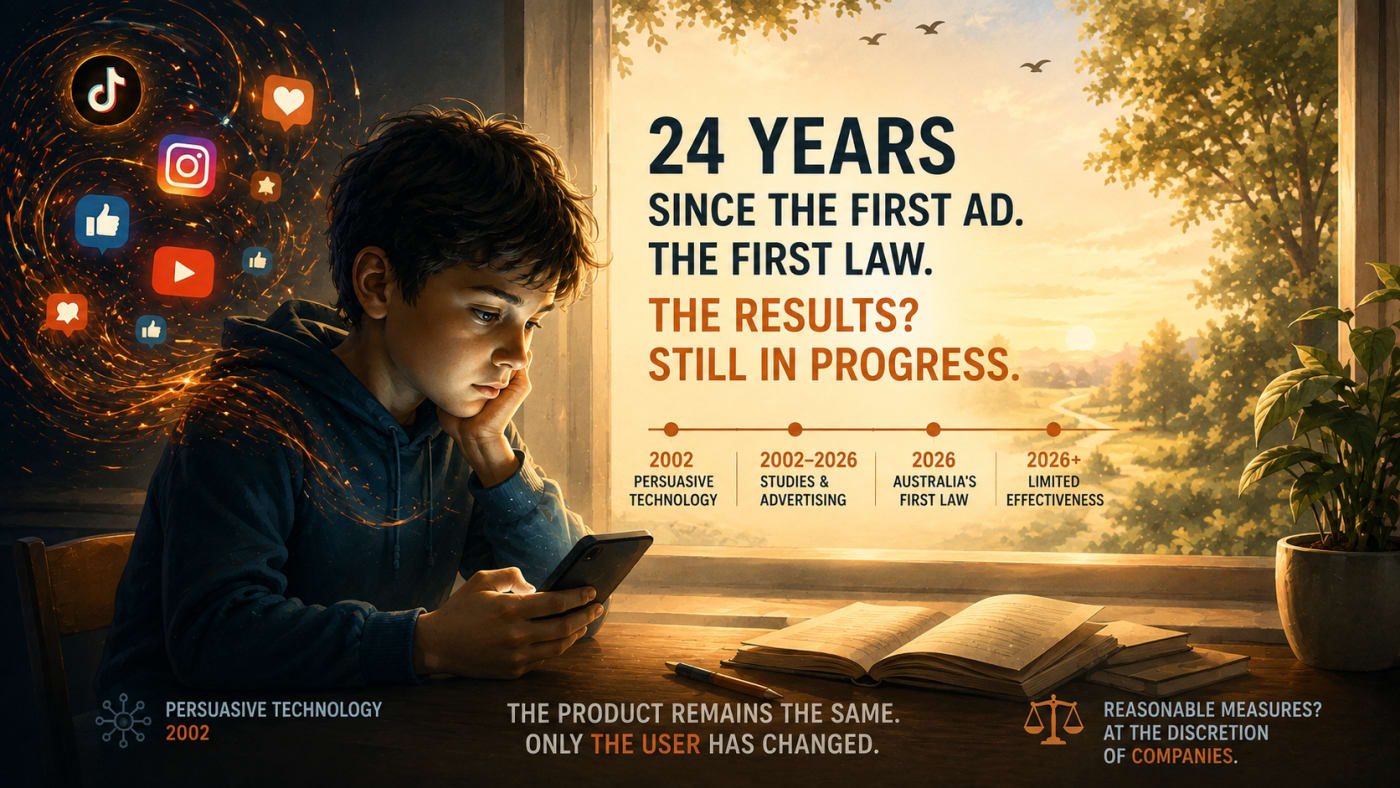
In 2002, American psychologist B.J. Fogg, a researcher at Stanford University, published Persuasive Technology: Using Computers to Change What We Think and Do. For the first time, a new field was defined: the design of digital technologies capable of intentionally influencing human behavior. Fogg warned even then that this power would inevitably raise two questions: who would control these technologies and whose interests would they serve?
Over the next two decades, the answer came from the industry itself. Digital platforms began building products based on algorithmic recommendations, constant notifications, autoplay and infinite scrolling, turning user attention into the main economic resource. At the same time, scientific research into the effects of these mechanisms on behavior and mental health increased year after year.
It took almost 24 years for this evolution to receive its first major political response. Australia became the first country to try to restrict by law an entire category of users from accessing major social media platforms, through what the legislation would call, rather modestly, “reasonable measures”. The law, which came into force in December 2025, can now be evaluated in terms of its impact, based on the dedicated eSafety study published in July 2026.
When the creators themselves began sounding the alarm
The first warnings did not come from politicians or regulators, but from within the industry itself.
In 2017, Sean Parker, Facebook’s first president, said that the platform’s mechanisms exploited “a vulnerability in human psychology”. Likes, comments and social validation were not designed merely to facilitate communication, but to make users return as often as possible and spend more and more time on the platform. In the same year, Chamath Palihapitiya, a former Facebook vice president responsible for user growth, described these mechanisms as “dopamine-driven feedback loops”, warning that they alter the way people relate to one another and affect the functioning of society.
A year later, Jaron Lanier, one of the pioneers of virtual reality, said that major social networks had become true “behavior modification empires”, built to constantly observe, anticipate and influence user behavior.
In 2019, Tristan Harris, a former Google design ethicist, described the competition between major platforms as “a race to the bottom of the brainstem”, arguing that commercial success was achieved by stimulating some of the most primitive psychological mechanisms: curiosity, social validation, fear, outrage and unpredictable rewards.
In just a few years, the language used to describe the same industry had changed radically. What in 2002 had been presented as “persuasive technology” was now being described by some of its own creators as the exploitation of psychological vulnerabilities, behavior modification and competition for the capture of human attention.
An image that has become normal
The scene has become so ordinary that we barely notice it anymore. Entire families sit at the same table without speaking. Parents push their children’s strollers without looking up from their phones. Teenagers cross the street with their eyes fixed on a screen. Friends meeting for coffee spend more time following an algorithm’s recommendations than talking to each other. At the same time, viral challenges have sent teenagers to hospital, while other cases have ended tragically in attempts to gain a few seconds of online attention. What initially seemed to be merely a new way of communicating has begun to change the way we use our time, concentrate, build relationships and even relate to reality. We will return in a separate article to the way it influences language and expression.
What the most comprehensive scientific review published so far says
In 2025, the prestigious journal Psychological Bulletin published the meta-analysis “Feeds, Feelings, and Focus”, one of the most comprehensive reviews devoted to the effects of short-form video platforms. The research brought together 71 independent studies involving 98,299 participants, providing one of the strongest scientific pictures available to date. The conclusions are remarkably consistent. Intensive use of these platforms is associated with reduced attention span, lower self-control and impulse control, poorer cognitive performance, higher levels of anxiety and stress, as well as an overall deterioration in mental health.
This meta-analysis is neither an isolated experiment nor the opinion of a single research team. It synthesizes the results of dozens of independent studies and currently represents one of the strongest scientific reference points for understanding the effects associated with intensive use of platforms built around algorithmic recommendations and short-form video. The first law of “reasonable measures”
After more than two decades of research and warnings coming even from within the industry, Australia decided to intervene. It was the first country to attempt to restrict children’s access to major social media platforms at a national level. The initiative did not emerge by chance. In the years preceding the law, research, parliamentary hearings and public debate repeatedly identified the same features as being responsible for excessive attention capture: infinite scrolling, algorithmic recommendations, autoplay, notifications and other persuasive design mechanisms. During the same period, European institutions began speaking openly about addictive design, suggesting that the problem was no longer only about the content being displayed, but also about how the platforms themselves were built.
Australia, however, chose a different solution. Instead of intervening in these features, the law introduced an age limit of 16 — the highest adopted up to that point by any country for access to major social networks. Platforms were not required to give up infinite scrolling, algorithmic recommendations or autoplay. They were simply required to prevent people under 16 from gaining access, through what the law called “reasonable measures”.
At first glance, the solution seems logical. If a product is considered dangerous for children, you prevent them from reaching it.
But this is where the first change in perspective appears. The problem identified by researchers concerned the product itself and the way it influences user behavior. The legislative solution did not change the product, but tried to restrict access for a single category of users. In other words, the law did not change the mechanisms considered problematic. It tried to change the user base. A task transferred directly to the industry
There is another essential detail. Australia did not establish the technical method by which the restriction had to be enforced. The law did not impose a single age-verification system. It did not require the use of a particular form of identification, nor did it define what, in practice, would count as sufficient verification. It simply stated the objective and left the platforms to decide for themselves how to achieve it. From the companies’ point of view, the law provided for very large financial penalties for non-compliance. On the other hand, those same companies had built their business models precisely around attracting users and keeping them on the platforms for as long as possible. The more time spent on the platform, the greater the number of ads displayed, the volume of data collected and the revenue generated. User attention is, in essence, the raw material from which profit is made.
In this context, Australia asked the industry to find its own solution for reducing access by a category of users without telling it exactly how this was to be done. A solution that was difficult to implement, and the difficulty was not only legal but also technical.
Experience in recent years shows that even countries with far more extensive communications-control mechanisms than those found in a Western democracy have encountered major difficulties in blocking access to digital platforms. Users have continued to rely on VPNs, intermediary services and other circumvention methods. Under these conditions, expecting millions of teenagers to be stopped exclusively through technical measures developed by the platforms raised serious questions from the very beginning.
Swedish analyst Björn Jeffery, one of the most attentive observers of European social media policy, noted that the public debate shifted very quickly from the question “Does this solution work?” to “How do we implement it?”. His observation captures the essence of the Australian experiment very well.
An age limit can temporarily reduce children’s access to a platform. It does not, however, change the product that generated the problem. The same direction can also be seen in OECD analyses and, increasingly, in the approach of European institutions, which are shifting the focus from simple age verification toward the assessment of addictive design features — infinite scrolling, autoplay, algorithmic recommendations and other mechanisms capable of influencing user behavior regardless of age.
The first results
Now, only a few months after the law came into force, the first official assessment has appeared. The results fell far short of the intended objective. The stated purpose of the legislation was to prevent people under 16 from using major social media platforms through their own accounts. Nevertheless, the study commissioned by the Australian authority eSafety showed that more than 80% of teenagers who had used social media before the law was adopted said they were still using it.
At the same time, the proportion of children aged 10 to 15 who said they had accounts fell from 52.4% to 42.1%. In other words, after one of the most widely discussed legislative initiatives in the world, the reduction achieved was approximately 20%.
The law aimed to restrict children’s access to the platforms. In practice, most of those who had used them before continued to do so after it came into force. For a large number of families, the legislative change did not translate into a real change in behavior. Access continued through existing accounts, by declaring a different age, through new accounts or through other means of circumvention.
The Australian experiment provides the most important lesson so far regarding social media regulation. The problem identified by researchers concerned the way the platforms are designed. The legislative solution was aimed almost exclusively at the user. This difference may appear minor. In reality, it completely changes the way the law works. If the product remains unchanged and the only intervention is to restrict access for a category of users, the effectiveness of regulation depends almost entirely on the ability to control who enters the platform and who does not. This is precisely where the greatest difficulties appeared.
By contrast, intervention in the product itself produces direct effects for all users, regardless of age. By intervention we mean: limiting infinite scrolling, modifying algorithmic recommendations considered harmful, reducing autoplay.
A debate that is only beginning
For the first time, a country attempted to respond through legislation to products designed to influence human behavior. Even though the results were limited, the Australian experiment has the merit of moving the discussion from warnings and academic studies into the realm of public policy.
In the coming years, this debate will almost certainly move to Europe. European institutions are already discussing addictive design, and the emphasis appears to be gradually shifting away from simple age verification toward the features that generate attention capture and compulsive use.
If this direction is confirmed, the question of the next decade may no longer be who is allowed to use these products, but how they should be designed so as not to exploit users’ vulnerabilities.
In 2002, B.J. Fogg asked who would control technologies capable of changing human behavior. Twenty-four years later, the answer is still being sought.
There is now hardly any serious dispute that digital platforms influence user behavior. Scientific research, former industry leaders and the first legislative initiatives all begin from this premise. The real controversy concerns something else.
Do we regulate users or do we regulate products? Australia chose the first option. It remains to be seen whether the rest of the world will follow the same path or attempt to address directly the causes that research has been identifying for more than two decades.


Comments
Comments are moderated before publication.
No approved comments yet.