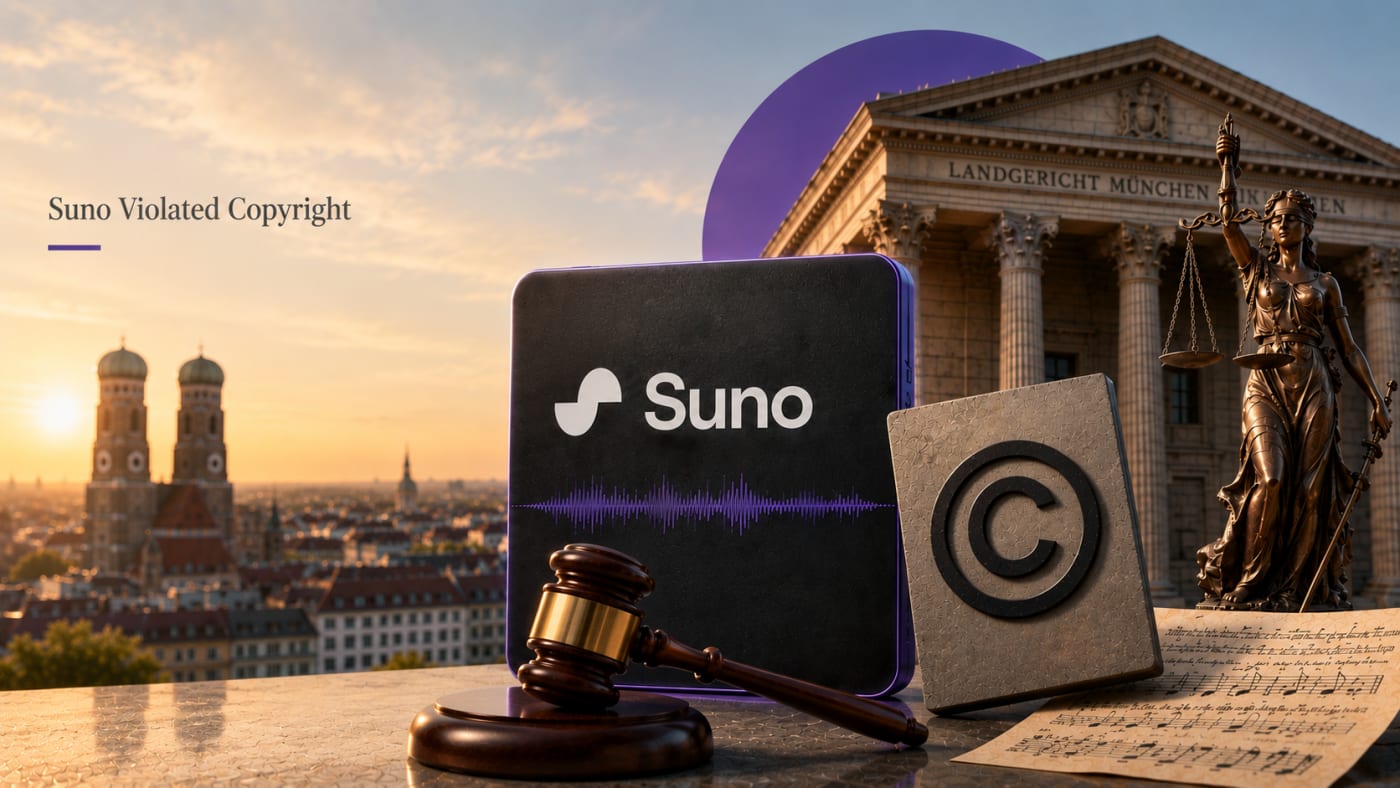
What the Munich Court Decided
The Regional Court of Munich found that Suno did not have the right to process, without authorization, music represented by GEMA, the German licensing agency that administers the rights of more than 95,000 composers and approximately two million rights holders worldwide. The case focused on six protected compositions, including “Rasputin” by Boney M. and “Forever Young” by Alphaville, which the court found had been copied and memorized during the model’s training process. The ruling prohibits four distinct categories of acts: reproduction for training purposes, even when it took place in the United States; memorization of the works within the model; making the tool available to the public; and generating outputs that reproduce the original works. As a result of the decision, Suno is also required to disclose the revenue it generated, a necessary step for the subsequent calculation of damages.
One important element highlighted by legal experts is the German court’s assumption of jurisdiction over training activities that took place entirely in the United States. If upheld on appeal, this territorial extension would mean that any AI company whose products reach users in the European Union could potentially be held liable under European law, regardless of where the model was actually trained. The ruling continues a line of reasoning that the same court had already begun developing in November 2025, when it ruled in a similar case that ChatGPT had infringed copyright by reproducing the lyrics of German songs.
The decision is not final. Suno has announced that it intends to appeal the ruling before the Munich Higher Regional Court, where the dispute will likely focus on the territorial reach of the court’s jurisdiction, the standard used to determine what constitutes the “memorization” of a protected work, and the 176 prompts used as evidence, according to an analysis published by law firm Reed Smith. Tobias Holzmüller, CEO of GEMA, called the verdict “a ruling of global significance,” stating, according to Deadline, that the court had “made clear today that AI models built on the theft of intellectual property do not enjoy legal protection.”
How Suno Ended Up in the Defendant’s Box
The dispute originated with a lawsuit filed by GEMA before the Munich Court in January 2025. The German agency argued that Suno, a company based in Cambridge, Massachusetts, had trained its models on copyrighted music without obtaining licenses or compensating the authors. The central argument made by the plaintiffs was, according to reports from the courtroom, difficult to dismiss: by entering lyrics, titles and style prompts into the platform, GEMA’s lawyers were able to generate Suno songs whose melodies and harmonies resembled, in the court’s words, “too much and too specifically to be coincidental” to compositions such as “Daddy Cool,” “Mambo No. 5” and “Cheri Cheri Lady.”
The financial stakes in the dispute are far from negligible: Suno was valued at $5.4 billion following a funding round completed in June. According to earlier journalistic investigations, the company may have trained its models on a catalog of more than two million songs collected from the internet. The company is facing legal pressure beyond Germany as well. More than 1,800 artists are supporting similar collective actions in the United States against Suno and its rival platform Udio, where a U.S. court is currently considering whether Suno should pay damages of up to $9.1 billion for more than 61,000 songs identified as having been copied. Udio already reached an agreement last year with Universal Music Group and Warner Music Group, while Suno has separately signed an agreement with Warner Music Group, the only major record label to have accepted a licensing deal with the platform so far.
Suno’s Policy Shift
A blog post signed by CEO Mikey Shulman, tellingly titled “How We’re Building the Future of Music Responsibly,” appeared less than a week after the Munich verdict and announced a series of measures designed to limit precisely the type of abuse documented by GEMA in court. The company will soon introduce a new download policy explicitly designed to make mass distribution of generated songs on streaming platforms more difficult. It will also launch watermarking and audio fingerprinting technology in the coming weeks and implement transparency tools aligned with emerging industry standards, allowing AI-generated songs to be identified on third-party platforms. Suno has also become the first company in the sector to integrate Sentinel, the copyright detection service developed by Musixmatch.
Robert Kyncl, CEO of Warner Music Group, reiterated this week that he expects Suno to transition fully to a licensed model later this year. The move comes, however, at a time when the volume of AI-generated content has reached a threshold that the music industry had long warned was critical. According to an official announcement by Paris-based streaming platform Deezer, fully AI-generated songs surpassed half of all new daily uploads on the platform for the first time in June, rising sharply from the 44% recorded in April, with an average of approximately 90,000 AI-generated songs uploaded every day. Although they dominate the flow of uploads, these songs still account for only 1–3% of actual listening, partly because Deezer excludes detected AI content from algorithmic recommendations and editorial playlists. The company’s internal data also shows that up to 85% of the streams recorded for AI-generated songs actually came from fraudulent bot accounts.
The Future of AI-Generated Music
The Munich decision is not an isolated incident, but part of a growing wave of litigation challenging the premise on which most generative AI platforms have been built so far. The approach assumed that training data could be collected freely, with any legal issues to be resolved later through negotiations or settlements. The fact that a European court has asserted jurisdiction over acts that took place on U.S. territory fundamentally changes the risk calculation for any AI company serving users in the European Union. If the appeal confirms the reasoning of the lower court, and if GEMA succeeds in obtaining the Europe-wide injunction it has announced it will seek until the dispute is resolved, pressure on unlicensed platforms to negotiate commercial agreements with rights holders before exploiting protected catalogs will increase significantly, turning licensing from a strategic option into a condition for survival in the European market.
Sources
- Reed Smith — “GEMA notches a second transatlantic AI copyright win in Germany”
- Forbes — “Suno Loses Copyright Lawsuit To GEMA—AI Music Companies Should Worry”
- Deadline — “German Court Rules Against Suno In Lawsuit Challenging Use Of Copyrighted Music In AI”
- Suno — “How We're Building the Future of Music Responsibly”
- Digital Music News — “Suno Announces Sweeping Download and Labeling Changes”


Comments
Comments are moderated before publication.
No approved comments yet.