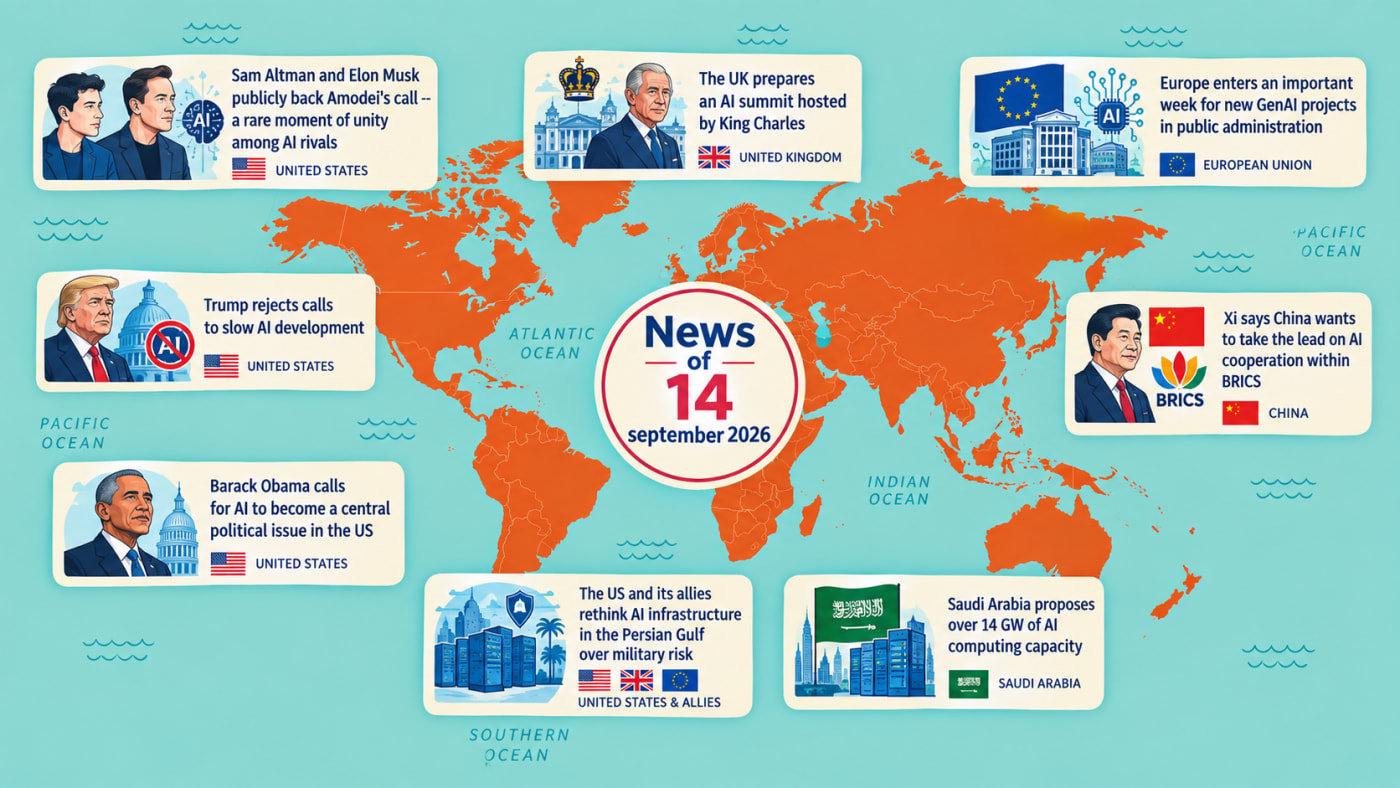
Sam Altman and Elon Musk publicly back Amodei's call -- a rare moment of unity among AI rivals
Dario Amodei's call to slow the pace of frontier AI model development has won public support from Sam Altman, CEO of OpenAI, and Elon Musk, founder of xAI, according to a report by The Guardian, also covered by AIdapted. Demis Hassabis, CEO of Google DeepMind, joined them as well. It's an unusual moment for an industry in which these companies compete directly for researchers, models, users, and infrastructure.
Why it matters: the news here isn't just Amodei's call itself, but the fact that his main rivals publicly acknowledge the same problem: AI capabilities may be advancing faster than safety mechanisms can keep up. According to Anadolu Agency's reporting from September 13, the discussion also touches on independent evaluations and external oversight. It's one of the rare moments where the leaders of the most powerful AI labs send a joint message about the need for caution, even as each company continues to invest heavily in model development.
Trump rejects calls to slow AI development
President Donald Trump, however, rejects the idea of slowing down the US AI industry. In remarks made on September 13 and quoted by Financial Times, he argued that the United States must maintain its edge over China and downplayed warnings about the risks of rapid technology development. The White House's position thus puts it directly at odds with the calls from Amodei, Altman, and Musk.
Why it matters: the dispute is starting to take the shape of a strategic choice for the US: safety through slower development, or a geopolitical edge through speed. According to The Washington Post, the Trump administration believes that any unilateral limit on American companies could benefit China. The AI question is becoming part of the competition for economic and military supremacy.
Barack Obama calls for AI to become a central political issue in the US
Former President Barack Obama has urged Democratic Party leaders to treat AI as a major political issue and to build a public debate around the safety and economic effects of the technology. According to Reuters, Obama warned at a private event that AI is developing very quickly in the hands of private companies and could become dangerous if society fails to keep pace with this evolution. He suggested that AI should become one of the central themes for candidates in the 2028 presidential election.
Why it matters: the remarks show that AI has firmly entered high-level American politics. The debate is no longer limited to regulating tech companies -- it now includes jobs, national security, existential risks, and the distribution of economic power. If AI becomes a central issue in the 2028 election, decisions about model development could turn into one of the major dividing lines between America's political parties.
Xi says China wants to take the lead on AI cooperation within BRICS
President Xi Jinping presented, at the BRICS summit in New Delhi and according to the Chinese Ministry of Foreign Affairs, a five-point plan for deepening economic and technological cooperation, with AI at the center of its digital component. China is proposing the development of an open-source AI community, cooperation on large language models, specialist training programs, cloud infrastructure, and collaboration in smart manufacturing.
Why it matters: Beijing is trying to turn AI into a tool for cooperation with the Global South (developing countries and emerging economies), rather than just a direct competition with the United States. According to Financial Express, a China-backed open-source platform could give BRICS states access to models, infrastructure, and know-how without total dependence on American companies.
The UK prepares an AI summit hosted by King Charles
King Charles is set to host in Scotland, according to The Times, a summit dedicated to AI development, expected to draw representatives from companies such as Nvidia, Anthropic, and OpenAI. The event is being framed as a discussion on how the technology can be developed so that its benefits serve society while remaining under human control.
Why it matters: the fact that such a summit is being hosted by the head of the British monarchy shows just how far AI has moved beyond the boundaries of the tech industry. According to The Independent, the UK is trying to remain a key hub for the global debate on AI safety and governance, and the presence of frontier companies gives London a role as an intermediary between industry, governments, and society.
The US and its allies rethink AI infrastructure in the Persian Gulf over military risk
The United Arab Emirates is revising its plans for an AI data center project of roughly 5 GW, one of the largest projects of its kind outside the United States. According to Reuters, the project, originally designed as a roughly 26-square-kilometer campus in Abu Dhabi, could be turned into a network of data centers spread across multiple locations in the Emirates. Options under consideration include underground construction, blast-resistant materials, and defense systems against drones and missiles.
Why it matters: AI infrastructure is starting to be treated as strategic infrastructure, on par with energy or communications. For the giant computing centers of the future, geopolitics could become a very important factor.
Saudi Arabia proposes over 14 GW of AI computing capacity
Saudi Arabia is working with the private sector to develop more than 14 GW of computing capacity, according to the Minister of Communications and Information Technology, Abdullah Al-Swaha, as quoted by Saudi Gazette. The announcement was made at the Frontier Leaders Forum 2026 in Silicon Valley. The Saudi strategy combines three elements -- computing capacity, capital, and access to customers -- aimed at attracting international AI companies and helping them scale up.
Why it matters: the 14 GW figure shows that Gulf states no longer just want to buy AI products -- they want to become part of the infrastructure the industry runs on. According to Arab News, Saudi Arabia is trying to attract companies by offering computing power, funding, and market access all at once. The model differs from Europe's: instead of starting with regulation, the Saudi strategy starts with capital, energy, and infrastructure to attract the companies building AI.
Europe enters an important week for new GenAI projects in public administration
The European Commission is launching on September 14, according to the European Commission, three pilot projects dedicated to the use of generative AI in public administration: FLOODS & DROUGHTS, EUNOMIA.AI, and EuropAI. The projects are funded through the Digital Europe Programme and aim to develop, test, and deploy European GenAI solutions for concrete administrative challenges. The launch event is followed by an Apply AI meeting focused on moving from experimentation to implementation, public procurement, technological sovereignty, and scaling solutions across Europe.
Why it matters: this is an important step for Europe. The projects are designed to address concrete needs while meeting European legal and operational requirements. According to Interoperable Europe, the discussion around procurement and sovereignty shows that the EU is trying to avoid a situation where European administrations become fully dependent on the infrastructure and models of companies from outside Europe.
Sources:
Interoperable Europe — Artificial Intelligence Solutions for Public Administrations, September 2026
The Times — King Charles to Host AI Summit in Scotland, September 2026
Financial Times — Trump Rejects Calls to Slow AI Development in Race With China, September 2026
European Commission — Kick-off for New GenAI Pilots in Public Administration, September 2026
Financial Express — Xi Proposes China-Led AI Ecosystem, September 2026
Reuters — Obama Voices Caution on AI, Urges Democrats to Tackle It, NYT Says, September 2026
Reuters — UAE Revises AI Data Center Plan After Iranian Attacks, Sources Say, September 2026


Comments
Comments are moderated before publication.
No approved comments yet.