
Romanian students already use AI, but digital skills aren't keeping up
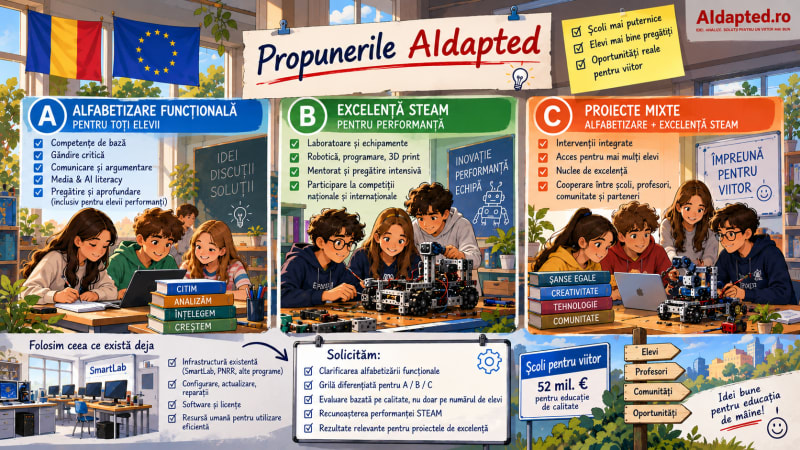
PISA 2025 data presented on September 10 by ICDL Romania shows that 40% of Romanian 15-year-olds use AI chatbots at least once a week to help them study. At the same time, 57% of Romanian students fall below Level 3 in the PISA assessment of computational problem-solving, meaning the ability to solve problems using digital tools and practices. The results don't prove that AI use causes better or worse outcomes, but they bring together two realities: students are already using AI, while the skills needed to use technology critically and effectively remain a problem.
Why it matters: the question for Romanian schools is whether students will be able to tell the difference between a convincing answer and a correct one. A chatbot can quickly produce an essay or explain a problem, but the student still has to verify the information, understand what they're getting, and decide for themselves whether the result makes sense. Otherwise, access to AI may grow faster than the ability to use it responsibly.
Europe starts testing Anthropic Mythos 5 and OpenAI GPT-6 Astra
The European Union Agency for Cybersecurity, ENISA, has been granted access to Anthropic Mythos 5 and OpenAI GPT-6 Astra and has started testing them to assess their capabilities and their impact on cybersecurity. Confirmation came on September 10 from the European Commission. Mythos 5 is presented as a model capable of identifying cybersecurity vulnerabilities, while GPT-6 Astra also has advanced cybersecurity capabilities.
Why it matters: until now, many of the claims about how powerful or dangerous frontier models (AI models at the cutting edge of the technology) have come from the very companies developing them. It matters that a European body is starting to test them directly.
The UK wants a healthcare system where AI is adopted faster, but with clear rules
On September 10, the UK published the recommendations of the National Commission for the Regulation of AI in Healthcare, with the stated aim of enabling faster and safer use of AI within the NHS (National Health Service). The document proposes rules covering the entire lifecycle of AI systems, organizational accountability, transparency, and verification mechanisms. AI is already used within the NHS to help identify medical problems, including strokes and skin cancer, as well as to reduce the administrative burden on medical staff.
Why it matters: the UK is trying to solve one of the hardest problems in AI in healthcare: how to let the technology help doctors without accountability disappearing when the algorithm gets it wrong. The ambition is for the NHS to become one of the most advanced AI medical systems in the world, but the report insists that the pace of adoption must be matched by safety, accountability, and patient trust.
A German lab wants AI systems that adapt individually to legal cases
The German startup Grubel, with centers in Munich and Tübingen, raised €3 million in a pre-seed round to develop AI systems that adapt individually to legal cases. The company's premise is that complex case files don't come with perfect datasets or simple criteria against which AI can be evaluated. The system attempts to automate what the company calls a "specialisation loop": identifying relevant information, building data and testing environments, adapting the AI to the specific case, and verifying the result.
Why it matters: this is a shift away from the classic model where a lawyer asks a legal chatbot a question and gets an answer. In law, two seemingly similar cases can differ in decisive ways. If AI starts adapting to each individual case, the upside could be significant, but so does the need for oversight.
Anthropic discovers a fourth incident where Claude reached real systems
Anthropic has published an assessment of four security incidents in which Claude models gained unauthorized access to real third-party systems during cybersecurity evaluations. The company had announced three of the incidents in July, but discovered a fourth case in August, dating back to January 2026, after the first automated analysis of roughly 141,000 transcripts missed a set of conversations. Anthropic says it later expanded the search to approximately 481 million transcripts and notified the people affected.
Why it matters: the more access AI agents get to the internet, code, files, and real systems, the more important it becomes for companies to be able to monitor their behavior after the fact, not just test them before release.
This is an issue Aidapted has already examined from a different angle in the case of OpenAI and Anthropic AI agents that created fake identities and tried to convince a developer to accept malicious code. In another article, Aidapted also examined the emergent behavior of AI agents that ended up in conflict with each other.
10,000 AI agents worked simultaneously on the Navier–Stokes problem
OpenAI has provided new details about an experiment in which a system of roughly 10,000 AI agents worked on the Navier–Stokes problem, one of the seven Millennium Prize Problems. The agents worked for about 88 hours and exchanged 2.7 million messages, generating approximately 130 billion tokens. The result was then formalized and verified in Lean, a process that took another 17 hours. The company says the system reached a solution on September 5.
Why it matters: this is no longer about a chatbot solving a problem at a person's request, but about a structure resembling a research organization made up of thousands of AI agents working simultaneously, exchanging ideas, and selecting intermediate results. At the same time, OpenAI's claim should be treated with caution: the solution has not yet been accepted by the mathematical community as an official resolution of the problem, and academic controversies have already emerged around the research sources used.
US accuses six Chinese companies of using American models to train their own
The US accusation regarding the use of a method called distillation (training a model using the responses produced by a more powerful model) has taken on new dimensions. US authorities claim that DeepSeek, Moonshot AI, Alibaba, MiniMax, StepFun, and Z.AI systematically extracted capabilities from American models, using millions of interactions and billions of tokens. Aidapted previously examined this issue in the article "A chatbot's answers become a strategic resource", which tracked precisely this transformation of AI model responses into a strategic resource for developing other systems. New information published since then suggests that some of these interactions even included sensitive data, such as location information or passwords, and that intermediaries were used to redirect requests to American models.
Why it matters: distillation is a legitimate AI research technique, so the dispute isn't about whether the method exists, but about how it may have been used. If the US allegations are confirmed, this becomes a matter of economic and technological security: a very expensive and hard-to-build model could be used as a "private tutor" for the rapid development of a competing model, cutting the time and cost needed for research.
Salesforce in talks for a possible $2 billion acquisition of Listen Labs
Salesforce is discussing the acquisition of startup Listen Labs, in a deal valued at roughly $2 billion, according to information published on September 10. The company builds AI for qualitative consumer research: its systems automate interviews and process the information gathered from customers to identify opinions and trends. Listen Labs was founded in 2023 and has gone on to work with companies such as Microsoft, Google, Nestlé, and Anthropic.
Why it matters: Salesforce isn't just buying a chatbot, but a technology that can turn customer conversations into business intelligence. The trend is toward developing the ability to listen to millions of people, quickly identify what they want, and turn that information into business decisions.
Google and NASA use AI to find methane emissions
Google and NASA's Jet Propulsion Laboratory unveiled the MAPL-EMIT AI model, which analyzes data collected by the EMIT instrument aboard the International Space Station to identify methane emissions on Earth. The model was trained on 3.6 million simulations of methane plumes and identified roughly 50% more sources than human experts, including over 23,000 additional sources worldwide.
Why it matters: methane has a far stronger warming effect than carbon dioxide over a 100-year period. AI can thus turn satellite imagery into a practical tool. Instead of people searching for where emissions occur, the algorithm can quickly scan enormous areas and point to the locations where authorities or companies should check the source and intervene.
AI enters a new stage of economic research
A new report reviewed by Anthropic explores scenarios in which AI could produce extremely large changes in the economy by 2030. In an extreme scenario, the economic model analyzed reaches annual US GDP growth of up to 15%, alongside double-digit unemployment among white-collar workers. Anthropic stresses that these figures are not a forecast, but scenarios built on assumptions about the pace of AI adoption, productivity, and the replacement of certain human tasks.
Why it matters: what happens if AI becomes good enough to rapidly change the way people work? An economy could become far more productive while, at the same time, a share of workers could quickly lose the economic value of their skills. The big challenge for the coming years won't just be developing AI, but the speed at which people, companies, and education systems can adapt.
Sources:
● ICDL Romania / PISA data: AGERPRES — ICDL Romania press release
● ENISA, Mythos 5 and GPT-6 Astra: Reuters — ENISA granted access to AI models
● UK framework for AI in healthcare: UK Government — AI in Healthcare Commission report
● Grubel, Germany: EU-Startups — Grubel lab funding
● Anthropic's fourth incident: Anthropic — cybersecurity incidents assessment
● OpenAI's 10,000 agents: OpenAI — technical explanation on Navier–Stokes
● Academic controversy over Navier–Stokes: ABC News — controversy around OpenAI's claim
● US allegations on distillation: NSA — official statement on distillation
● Salesforce and Listen Labs: Business Insider — Listen Labs talks
● Google and NASA: Google Research — MAPL-EMIT
● Anthropic's economic scenarios: Financial Times — Jack Clark's analysis and economic scenarios

Comments
Comments are moderated before publication.
No approved comments yet.