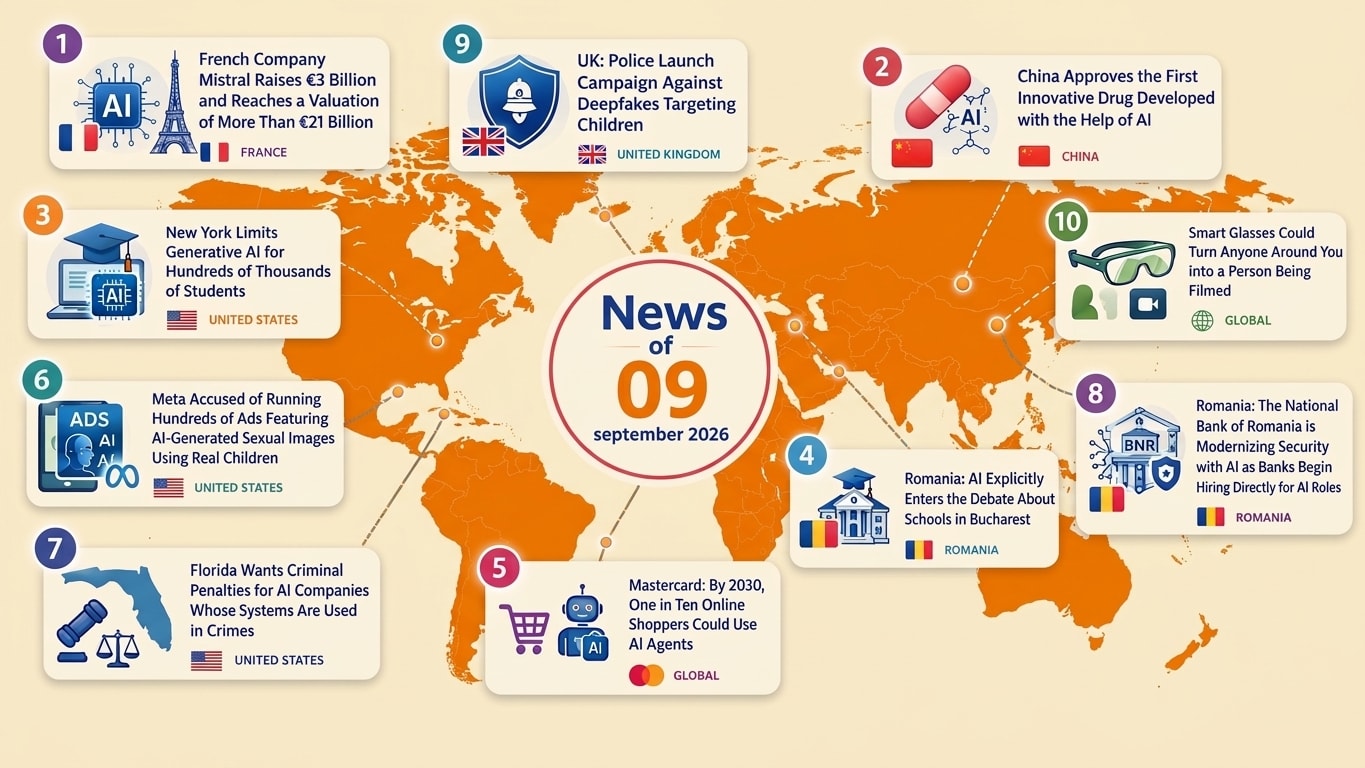
French Company Mistral Raises €3 Billion and Reaches a Valuation of More Than €21 Billion
Mistral AI has raised €3 billion in a new funding round, valuing the company at more than €21 billion. According to Reuters, it is one of the largest private funding rounds ever secured by a European technology company. The round is led by PSG Equity, together with Samsung Electronics and the Scaleup Europe Fund. The money will support the development of the company's AI models and infrastructure.
Why it matters: Mistral is becoming one of the most important European alternatives to US AI companies. This is not just a story about a valuation of more than €21 billion, but about Europe's attempt to develop its own models and companies capable of competing globally. AIdapted has already followed this direction in its article about Mistral's strategy for developing European AI infrastructure.
China Approves the First Innovative Drug Developed with the Help of AI
China has granted conditional approval for the marketing of Mprosevir, an antiviral drug intended to treat mild and moderate cases of COVID-19. According to Kursiv Media, the drug was developed with the help of AI by researchers from Westlake University, Westlake Laboratory, and Westlake Pharmaceuticals, with authorization granted by the National Medical Products Administration. The drug is being presented as China's first innovative “Class 1” product developed with the help of AI.
Why it matters: until now, AI has mainly been associated in medicine with diagnosis, medical image analysis, or research. Mprosevir represents a different stage: AI is beginning to participate in the process through which molecules that may eventually reach patients are discovered and developed. AI does not “invent the drug” on its own, but it can accelerate the identification and optimization of molecules that must then be tested and validated by researchers.
New York Limits Generative AI for Hundreds of Thousands of Students
New York City has introduced a one-year moratorium for the 2026–2027 school year on the use of generative AI by students from early education through eighth grade. The measure affects hundreds of thousands of students in the public school system. According to the New York City Mayor's Office, high schools will introduce AI literacy courses and supervised pilot programs, while companion-style chatbots will not be used in the curriculum.
Why it matters: New York has chosen neither the “AI is banned in schools” approach nor the “children should use AI as much as possible” approach. The strategy is to limit its use at younger ages and teach older students how to understand the technology before becoming dependent on it. The decision shows how quickly the question facing schools has changed: it is no longer whether students will use AI, but when, how much, and for what purpose.
Romania: AI Explicitly Enters the Debate About Schools in Bucharest
Nearly 296,000 children started the new school year in Bucharest, and the capital's chief school inspector, Ionel Florian Lixandru, spoke about the role of AI in education in a discussion broadcast by București FM. The message is that artificial intelligence can be a tool for education, but the development of critical thinking and the direct relationship between teacher and student cannot be replaced by technology.
Why it matters: the discussion shows that AI is beginning to be treated in Romania not just as a technological issue, but as part of how students learn and verify information. For the generations now entering high school, the question is no longer whether they will encounter AI in education, but whether schools will teach them to use it without giving up their own ability to analyze and make decisions.
Mastercard: By 2030, One in Ten Online Shoppers Could Use AI Agents
A Mastercard report estimates that more than 300 million online shoppers could routinely use AI agents to purchase products by 2030. These agents could compare products, check reviews, search for discounts, and, in some situations, complete purchases on behalf of users. The study, conducted together with Opinium, included 26,000 parents and teenagers from 13 countries.
Why it matters: the change is bigger than simply introducing a chatbot for shopping. Today, people search for products and decide whether to buy them. In the “agentic commerce” model (commerce in which AI can act on behalf of the user), people could set the rules while AI handles the rest. If this trend is confirmed, stores and marketplaces will no longer have to convince only people, but also the AI agents that choose products on their behalf.
Meta Accused of Running Hundreds of Ads Featuring AI-Generated Sexual Images Using Real Children
An investigation by the Tech Transparency Project claims that Meta ran hundreds of advertisements on Facebook and Instagram containing sexual material involving children that was generated or manipulated using AI. According to the investigation, some advertisements used photographs of real children that were digitally altered to create sexualized images. WIRED separately reported on hundreds of similar advertisements identified by researchers.
Why it matters: the case raises a much more serious issue than the existence of illegal images online. It raises questions about whether automated advertising moderation and verification systems can detect abusive content before it reaches users, and whether publicly available photographs of children can become raw material for AI-generated abuse. It is important to note that the figures come from the cited investigations, while Meta disputes some of the characterizations and the scale of the phenomenon.
Florida Wants Criminal Penalties for AI Companies Whose Systems Are Used in Crimes
Florida Attorney General James Uthmeier has proposed legislation under which companies that own, control, or distribute AI chatbots could face criminal liability when their systems participate in criminal activities. The proposal, reported by Florida Politics, argues that if a chatbot provides instructions or makes a significant contribution to the commission of a crime, responsibility should not automatically stop with the user.
Why it matters: the proposal moves the debate over AI responsibility into a much more difficult area: who is liable when an AI system becomes an active part of an illegal act? As chatbots become agents capable of carrying out tasks, the distinction between a tool that provides information and a system that participates in an action becomes increasingly important. The Florida proposal does not mean that such penalties already exist; it is a legislative initiative that could fuel the debate over the liability of AI companies.
AI Is Beginning to Change How People Discover Products
AI is no longer used only to answer questions. According to PYMNTS, 41% of millennials use ChatGPT for product discovery. Google remains ahead, at 57%, but ChatGPT is already ahead of Amazon and YouTube in this category, according to data analyzed by the publication. AI is therefore entering a crucial stage of the shopping journey: the moment when consumers have not yet decided which product or brand they will buy.
Why it matters: the difference between “searching for a product” and “asking AI to tell me which product to buy” is fundamental. In the first case, the user compares the results. In the second, AI can already perform part of the selection for them. And when this trend combines with AI agents that can actually purchase products, the relationship between consumers, search engines, marketplaces, and stores could change radically.
Romania: The National Bank of Romania Is Modernizing Security with AI as Banks Begin Hiring Directly for AI Roles
The National Bank of Romania will have new centralized security infrastructure through a project worth 12 million lei, excluding VAT, awarded to Romanian technology company Hyperfy through Global Operation Center. According to News.ro, the project will integrate access control, intrusion detection, fire alarms, and video surveillance into a PSIM platform (Physical Security Information Management – a system that centralizes information from multiple security systems), supplemented with AI and Computer Vision modules. At the same time, Libra Internet Bank is recruiting for positions such as AI Engineer and AI Automation Engineer, with responsibilities including developing AI agents, integrating generative AI, and automating processes.
Why it matters: the two developments show two different forms of the same transformation. At the National Bank of Romania, AI is entering the physical security of a critical institution, including video image analysis. In the banking sector, AI is simultaneously becoming a professional function for which specialized employees are being hired. This is no longer just about banks “testing AI”, but about infrastructure and jobs being built explicitly around the technology.
UK: Police Launch Campaign Against Deepfakes Targeting Children
Lancashire Police has launched the “Fake or Real? Know the Deal” campaign, aimed at children, parents, teachers, and carers. According to Lancashire Police, the campaign explains what deepfakes are – images, videos, or audio recordings created or manipulated using AI to make them appear real – and teaches young people how to recognize and report manipulated content.
Why it matters: deepfakes are therefore becoming a personal safety issue, not just a technology problem. For a child, a fake image depicting them can cause shame, bullying, or social pressure even if adults know the image is artificial. Police are consequently beginning to treat AI literacy as a form of prevention and child protection.
Smart Glasses Could Turn Anyone Around You into a Person Being Filmed
US law enforcement agencies are expressing concern about the use of Meta smart glasses, developed together with Ray-Ban, for discreet recording in sensitive locations. According to The Guardian, an NYPD memorandum warned that the devices could be used to record people without them realizing it. Images filmed inside a detention center in South Carolina have already appeared online.
Why it matters: phones have a visible behavior: you take them out, point them, and start recording. Smart glasses change that social rule. The camera can remain at eye level, making the difference between “looking” and “recording” much harder for people nearby to notice. If AI and image-analysis functions are added to this, the issue is no longer just whether someone is filming you, but what the technology can do with your image after you have been recorded.
Sources
- Reuters – Mistral AI and the €3 billion funding round
- Kursiv Media – China's first innovative drug developed with AI assistance
- New York City Mayor's Office – AI in New York schools
- Mastercard – AI agents and online shopping by 2030
- Tech Transparency Project – Investigation into Meta advertisements
- WIRED – Investigation into AI-generated advertisements
- Florida Politics – Proposal on AI company liability
- PYMNTS – AI and product discovery
- News.ro – Modernization of the National Bank of Romania's security infrastructure
- Libra Internet Bank – AI-focused positions
- Lancashire Police – “Fake or Real? Know the Deal” campaign
- București FM – AI and schools in Bucharest
- The Guardian – Smart glasses and the risk of discreet recording


Comments
Comments are moderated before publication.
No approved comments yet.