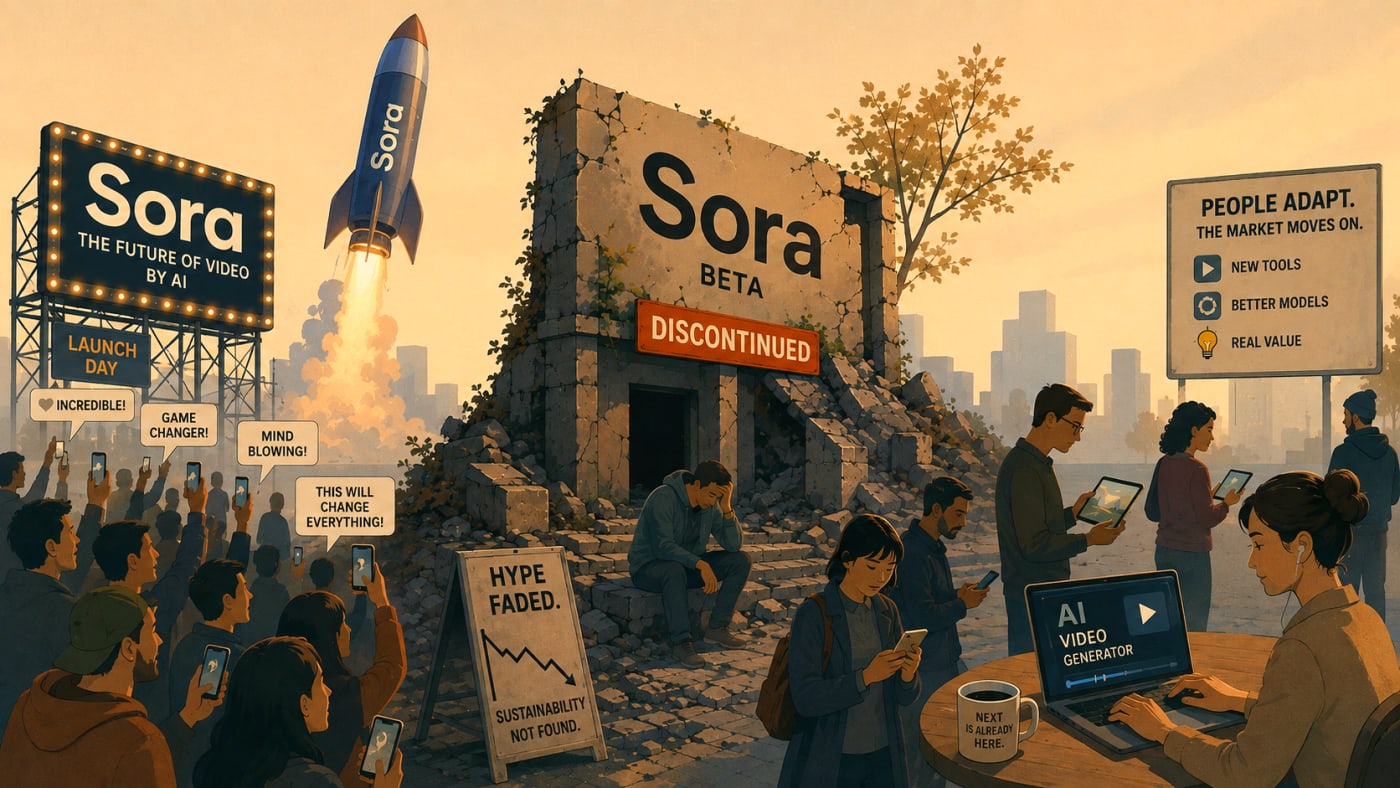
There is a particular kind of silence that always follows a spectacular failure, and Sora received exactly that treatment. Just over a year ago, the product was hailed as proof that AI video generation had reached its own "GPT-3.5 moment"—capable of simulating real-world physics with a level of realism that made competing systems seem obsolete. Then, on an otherwise ordinary evening in March 2026, it disappeared through a brief post on X. There was no press conference, no retrospective, no detailed explanation. Just a goodbye and two dates on the calendar: the application would shut down on April 26, and the API would follow on September 24. For a product that had once embodied OpenAI's ambitions to expand beyond chat, it was a remarkably quiet ending.
And that silence is precisely what makes the story interesting. When a company that has invested hundreds of millions of dollars in research and marketing—creating enormous expectations in the process—chooses not to discuss the real reasons behind a product's withdrawal, silence becomes an answer in itself. What did OpenAI choose not to say about Sora, and what does its demise reveal about the broader AI video generation industry?
The Numbers OpenAI Neither Confirmed Nor Denied
The official explanation for Sora's shutdown, if it can even be called that, occupies only a few paragraphs in OpenAI's FAQ. The real story, pieced together over time through financial reporting and business publications, is far less elegant: Sora had simply become an extraordinarily expensive product whose operating costs could not be sustained by any realistic number of paying users.
The Wall Street Journal reported operating costs of roughly $1 million per day, while other industry estimates placed the figure as high as $15 million per day during periods of peak demand. By comparison, lifetime in-app purchase revenue was estimated at only $2.1 million—not enough to cover even a few days of operation at the reported cost levels.
In almost any other industry, such a discrepancy would have triggered a financial scandal. In AI, it barely registered. Everyone already understands that generating video is vastly more expensive than generating text or images. A video model must produce and synchronize dozens—or even hundreds—of coherent frames while maintaining consistency across characters, objects, and, in the latest versions, synchronized audio. All of that requires enormous computational power and correspondingly high operating costs. Sora was among the most expensive consumer AI products ever offered to the public.
High operating costs, however, were only part of the problem. After the initial wave of excitement faded, downloads and active users began to decline rapidly. Downloads peaked toward the end of 2025 before falling sharply in early 2026. Active users followed the same trajectory. Even professional creators—the very customers expected to form the backbone of the product's monetization—gradually abandoned the platform as the novelty wore off.
The problem was not that Sora was slower or more expensive than traditional video production. For rapid concept generation and storyboarding, it was often both faster and cheaper than conventional workflows. The issues lay elsewhere. Character consistency frequently broke down between clips, requiring hours of manual correction. Video length remained limited to roughly 10 to 25 seconds. The monthly credit system, under which unused credits simply expired, made budgeting client work almost impossible. Reliability also became an issue: during periods of heavy demand, generations would sometimes stall indefinitely at 99 percent or fail altogether.
A tool that produces an impressive ten-second viral demo is not automatically a tool on which professionals can build predictable production pipelines with fixed deadlines and reliable budgets—especially when competitors such as Kling offered significantly lower costs and Runway provided much more sophisticated editing controls. Sora's early technological advantage was steadily eroding.
Disney, Deepfakes, and a Reputation That Deteriorated Faster Than the Model
If Sora's economic problems explain why it no longer made sense to continue investing in the product, its reputational problems explain why it no longer made sense to try to save it.
The platform quickly became associated—in both the media and online discussions—with the uncontrolled generation of copyrighted characters and with deepfakes realistic enough to raise serious concerns about consent and the unauthorized use of real people's likenesses. Repairing that kind of reputation requires far more than releasing a better model. It demands sustained investment in moderation systems, usage policies, and technical safeguards—the very expenditures a product already losing money is least able to justify.
In that context, few episodes better illustrate how quickly confidence evaporated than the collapse of a licensing agreement with Disney that would reportedly have brought Marvel, Pixar, and Star Wars characters to Sora. The partnership fell apart shortly before OpenAI announced the product's retirement, and Disney executives were reportedly informed only shortly before the decision became public. The episode speaks volumes about how abruptly—and with how little ceremony—the decision was made inside OpenAI.
The broader lesson is difficult to ignore: once a product begins losing both money and the market's trust, restoring its reputation can become more expensive than simply walking away.
This Isn't the End of AI Video. It's the End of a Poorly Calculated Bet
This brings us to the question that really matters for anyone working with media: does Sora's demise signal structural problems across the entire AI video generation industry, or does it simply demonstrate that OpenAI's strategy was flawed?
The evidence suggests the latter.
Just weeks after Sora disappeared, the rest of the industry looked far more vibrant than shaken. Runway continued to strengthen its position as the leader in the professional market. Kling, Kuaishou's video generation model, kept gaining ground thanks to its highly competitive cost-to-performance ratio. Google's Veo continued expanding into the enterprise market through its native integration with Google Cloud and YouTube, while ByteDance's Seedance and Pika each consolidated their own market niches.
In other words, the market not only survived the disappearance of what had once seemed its most promising player—it continued to grow. Meanwhile, Sora's competitors appeared to have solved precisely the problem that Sora never could: the balance between operating costs and revenue.
Most competing video generation platforms were never designed primarily as spectacular demonstrations of what foundation models could achieve. Instead, they were built as tools for real production workflows, where predictability and productivity matter just as much as visual realism. The difference was not necessarily one of technical capability. Rather, the technological demonstration failed to evolve into a sustainable business.
Video generation remains, by its very nature, the most computationally expensive category of generative AI, and those costs will continue to force every company—not just OpenAI—to pursue ever more efficient business models. The difference is that much of the industry accepted this constraint from day one, while OpenAI appears to have chosen instead to redirect its computing resources toward other priorities: Codex, enterprise products, and the long-rumored "super app" intended to unify ChatGPT with the company's broader ecosystem.
Viewed from that perspective, shutting down Sora was not merely the story of a product that failed. It was also a resource allocation decision in an industry where computing power remains one of the most valuable—and scarce—commodities.
Will Anyone Miss Sora? Probably Not—and That's the Uncomfortable Conclusion
For most people who create media content, from marketing agencies to independent creators, the honest answer is probably no. Sora's absence is unlikely to be felt very deeply—or for very long.
Not because Sora was a bad product, but because its replacements are not hypothetical. They already exist. They are mature and, in many respects, technically superior: Veo and Seedance offer stronger native audio generation, Runway provides more sophisticated editing controls, and Kling delivers a significantly lower cost per generated second of video.
Those most affected will likely be developers who built direct integrations with the Sora API and organizations relying on third-party aggregation platforms that offered access to multiple video models under a single subscription. For them, September 24, 2026 represents a genuine deadline rather than a theoretical one. Even then, however, migration is likely to be an inconvenient engineering exercise rather than an irreversible loss of capability.
More broadly, Sora's story illustrates how little the spectacle of a product launch ultimately says about its longevity.
At its debut, Sora was arguably the most impressive AI-generated video technology the public had ever seen. From today's perspective, however, its disappearance says less about the limitations of AI video generation than about the maturation of the AI industry itself. It is one of the first significant examples of a market rejecting not an insufficiently capable technology, but an insufficiently viable business model.
During the first years of the generative AI boom, competition revolved almost entirely around a single question: Who has the best model?
Today, a different question is beginning to matter more: Who can turn the best model into a sustainable product?
The distinction is profound. It marks the transition from an industry dominated by research breakthroughs to one increasingly defined by execution, operational discipline, and business fundamentals.
Perhaps that is Sora's real autopsy.
We are not witnessing the death of a product because the technology failed. We are witnessing the failure of a technological breakthrough to become a viable business.


Comments
Comments are moderated before publication.
No approved comments yet.