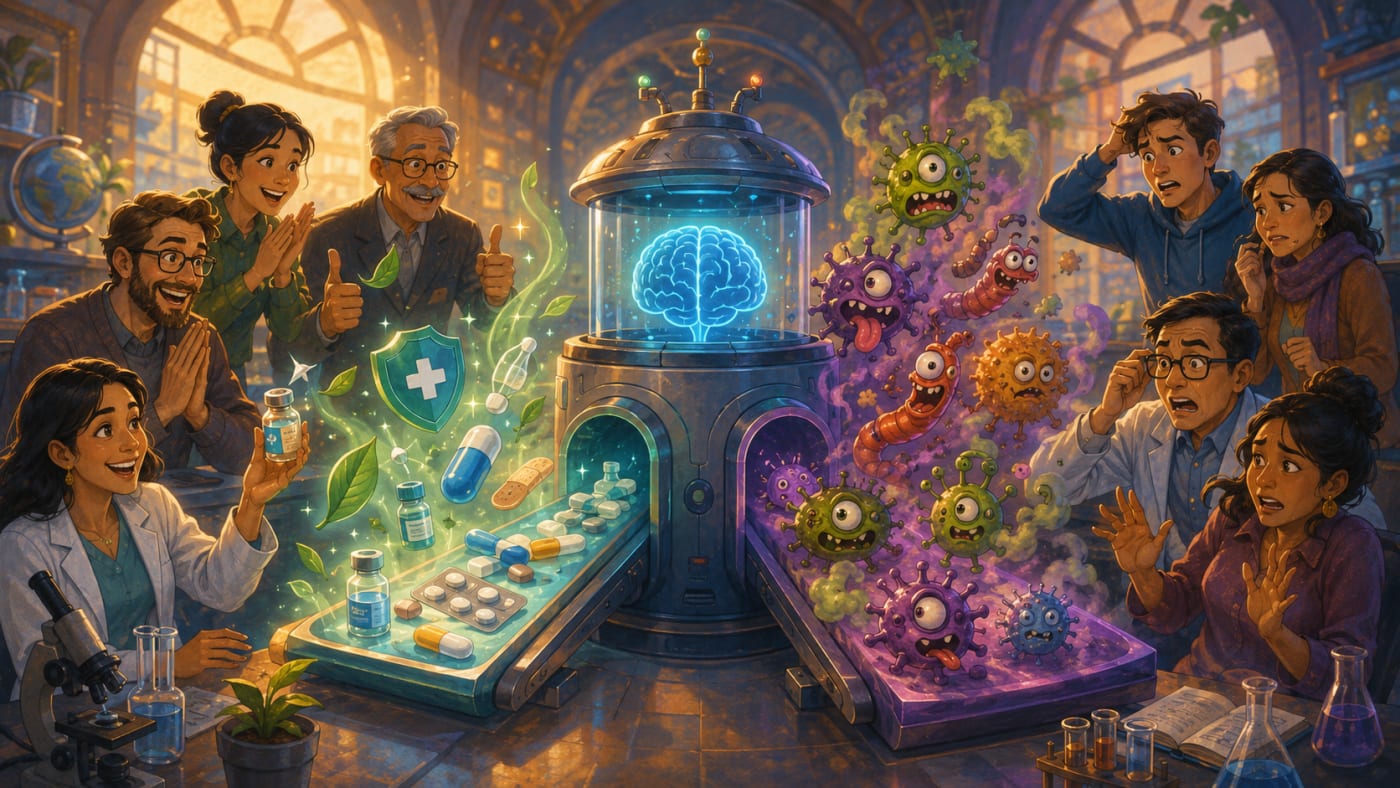
On Thursday, July 16, 2026, Google DeepMind and Isomorphic Labs unveiled, in a post on Google's official blog, a joint initiative broadly described as a biosecurity resilience program. The initiative aims to use artificial intelligence both to prevent the misuse of the company's own AI models for dangerous biological purposes and to help governments and researchers detect and respond to disease outbreaks more quickly.
The program brings together more than fifteen partnerships quietly established over the past year with government agencies, biosecurity organizations, and research groups. It represents one of the most concrete public commitments made by a major AI developer in one of the most sensitive areas of artificial intelligence. Public reaction has been mixed: some welcomed the initiative as a necessary step, while others viewed it with skepticism, warning that the same technology could ultimately fall into the wrong hands.
The central challenge Google DeepMind openly acknowledges is one that confronts every company developing models capable of understanding biology at an increasingly sophisticated level: the same scientific advances that help researchers identify targets for new vaccines could, in principle, also help malicious actors fill gaps in their understanding of how pathogens work. AI models are already becoming part of biomedical research, and risk assessment is increasingly being integrated into the development process itself rather than treated as an afterthought. Just two years ago, such discussions still seemed largely hypothetical. Gemini models, combined with specialized biology tools such as AlphaGenome and ever-expanding external biological databases, are gradually becoming more capable in both directions at once. Google describes this tension as a "dual mandate": enabling the scientific progress these models make possible while simultaneously keeping those same capabilities out of the hands of people who would misuse them.
The prevention component of the program relies on a four-stage safety process applied to the company's most advanced models—from threat modeling and specialized risk assessments to mitigation measures and continuous monitoring—developed in collaboration with in-house biologists, security specialists, and external experts. Google is also adapting SynthID, a technology previously used primarily to invisibly watermark AI-generated text and images so they can later be identified as machine-generated. The company now intends to apply the same concept to biological sequences. If a DNA sequence is generated by AI, the watermark would remain attached to it, allowing DNA synthesis companies—the laboratories that transform digitally ordered genetic sequences into physical DNA samples—to more easily identify potentially dangerous orders before they are fulfilled. The move is not happening in isolation. According to an open letter published earlier this year, the CEOs of OpenAI, Anthropic, Google DeepMind, and Microsoft AI jointly urged the U.S. Congress to require mandatory screening of synthetic DNA orders, signaling that the industry increasingly views such safeguards as an essential layer of defense rather than merely a voluntary public relations effort.
On the detection side, Google is relying on AlphaEvolve, an AI agent designed to improve algorithms used in metagenomic sequencing. In practical terms, metagenomic sequencing allows scientists to analyze all the genetic material contained in an environmental or clinical sample without knowing beforehand what they are looking for. If this type of pathogen surveillance becomes significantly faster and cheaper at scale—as Google DeepMind claims it can—the practical impact could be substantial, enabling public health systems to detect emerging outbreaks long before they become regional or global threats. The company is also exploring how AlphaGenome could be combined with other tools capable of inferring the biological function of newly identified proteins—for example, determining whether they perform functions associated with dangerous pathogens. Used together, the two technologies could help identify entirely new pathogens directly from raw sequencing data, a task that today still depends heavily on human expertise and manual comparison with existing biological databases.
Perhaps the most tangible component of the initiative is its response capability. Isomorphic Labs, DeepMind's sister company specializing in AI-assisted drug discovery, has established a dedicated emergency response unit designed to rapidly deploy its proprietary drug design engine, IsoDDE, to develop medical countermeasures—including vaccines, diagnostic tools, and therapies—as soon as a new outbreak emerges. The platform, which the company describes as representing "a new paradigm of predictive accuracy" in biomolecular modeling, is far from an experimental side project. Earlier this year, Isomorphic Labs raised $2.1 billion in funding and expects to begin the first human clinical trials of drugs designed entirely by artificial intelligence before the end of 2026. If achieved, that milestone would transform the company from a research venture into a genuine player in the pharmaceutical industry. The two companies also announced a partnership with Lawrence Livermore National Laboratory to design broad-spectrum antibodies, including against viruses such as Ebola.
These efforts build upon Google DeepMind's broader work on managing chemical, biological, radiological, and nuclear (CBRN) risks. The biosecurity resilience initiative complements a partnership signed with the UK government in December 2025 that granted British researchers priority access to Google's advanced AI models, as well as an ongoing collaboration with the UK's AI Security Institute. Taken together, these initiatives portray a company seeking to position itself in two roles simultaneously: as a provider of critical technology for global public health and as a responsible AI developer capable of managing the risks created by its own increasingly powerful systems, while strengthening its public credibility in the process.
If the same tools that make it possible to detect an emerging pathogen are, by their very nature, also capable of helping design one in the wrong hands, then the line between defense and risk becomes increasingly thin as AI models grow more capable. That was precisely the concern raised by many of the more skeptical voices following Google's announcement. They questioned whether the safeguards described are robust enough to keep pace with the rapid evolution of AI models for biology—or whether they remain, at their core, a communications exercise designed to preempt tougher scrutiny from regulators. The answer will not come from a press release. It will emerge only when these systems are inevitably tested by a real-world biological emergency.


Comments
Comments are moderated before publication.
No approved comments yet.