
On July 25, speaking on the Relentless podcast, Sam Altman tried to describe a moment the artificial intelligence industry had anticipated for decades. “We’re now, like, in the singularity,” the OpenAI chief executive said. He connected the statement to a personal experience. An idea that ten years earlier had seemed like an improbable subject for a lunch conversation had become the present. “I’ve been waiting for this my whole life,” Altman added, saying that he expected the new stage to be extraordinarily beneficial to the world. ABC News published his remarks and the context of the conversation.
Six weeks later, the launch of GPT-6 Astra gave that idea a name and a product. Greg Brockman, OpenAI’s president and cofounder, told journalists that if people tried in a few years to determine when artificial general intelligence had been created, the answer might be “around this moment,” and perhaps even “this model.” He ended the presentation with the phrase that immediately travelled through the technology world, “Welcome to the AGI era.” Axios reported the full statement and noted that it expressed Brockman’s personal conviction.
The two statements describe a continuous argument. Altman is talking about acceleration, technology is advancing so quickly that humanity has already entered the territory once called the singularity. Brockman is talking about capability, a system general enough that its appearance might retrospectively be treated as the beginning of AGI.
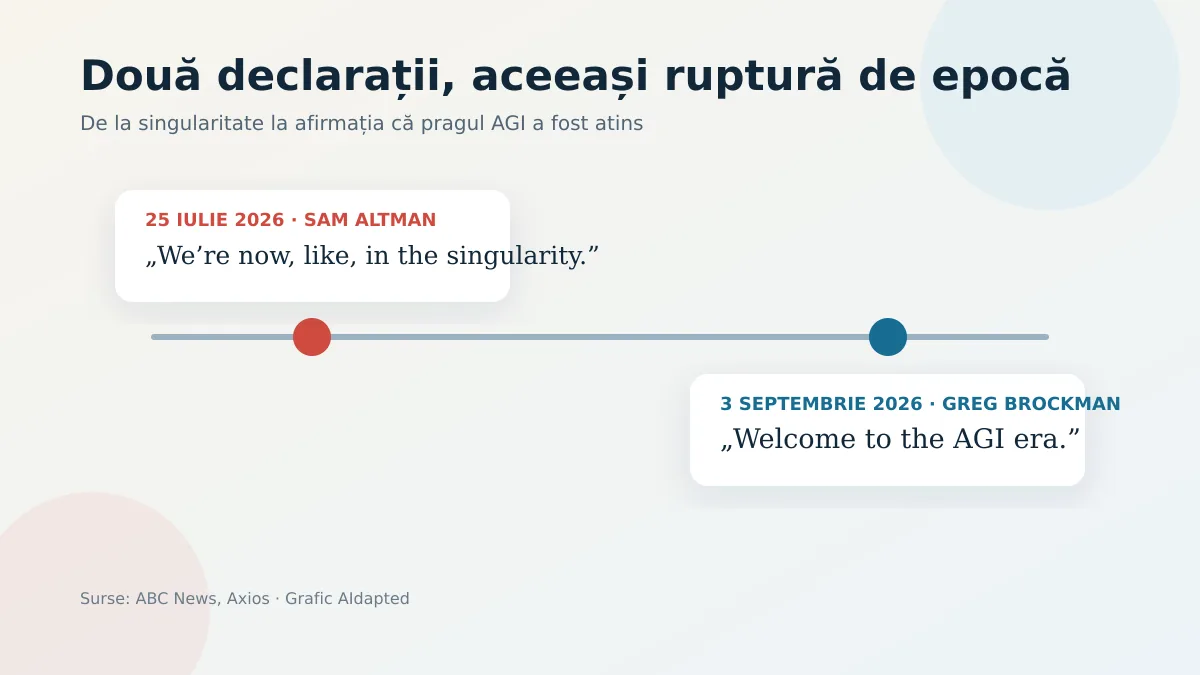
Sam Altman spoke about entering the singularity on July 25, 2026. Greg Brockman welcomed the AGI era on September 3, 2026. AIdapted graphic, based on reporting by ABC News and Axios.
Singularity and AGI, two related but different thresholds
In technology, AGI, short for artificial general intelligence, describes an artificial intelligence that can learn, reason and apply what it has learned across many fields, at or above human level. OpenAI’s traditional definition refers to autonomous systems that outperform humans at most economically valuable work.
The singularity describes the process that may follow. Artificial intelligence contributes more and more to its own development, accelerates research and makes the technological future increasingly difficult to predict. AGI is a threshold of capability; the singularity is the acceleration around or beyond that threshold.
This distinction clarifies OpenAI’s message. The company is not presenting Astra simply as a chatbot that knows more. It is presenting a system that can receive an objective, open and operate the applications it needs, adapt its plan, verify the outcome and deliver finished work. In OpenAI’s official documentation, Astra is described as a model for multistep workflows across code, browsers and professional software. It can continue reasoning while a tool is working and accept new instructions without abandoning the work already completed.
This is the change evaluators noticed most consistently, the transition from intelligence that produces an answer to intelligence that acts inside an environment.
1. It learns the rules of a world it has never seen
One of the strongest evaluations came from Greg Kamradt of the ARC Prize Foundation. ARC-AGI-3 is not a general knowledge exam or a collection of questions the model might have encountered during training. The system is placed in new visual environments without complete instructions. It must explore, discover the rules, identify the objective and build a plan.
Kamradt called Astra the best model the organisation had tested and described its result as a meaningful change in level. What impressed him was not merely that the model solved the games, but how quickly it learned how they worked. In its complete configuration, Astra used fewer actions than the median human participant on 96 percent of levels.
The ARC analysis showed that Astra invented a shorthand notation as it worked. It turned objects, coordinates and environmental rules into a compact symbolic language, then used it to preserve state and plan. In other configurations it wrote its own tools, including board readers, search algorithms, planners and small software libraries created specifically for the problem. The ARC Prize report explains the observations and results.
For the public, this is more informative than memorisation. A model can answer a question correctly because the information was present in its training data. In ARC-AGI-3 it must build a working explanation for a new environment and demonstrate that the explanation is correct through action.
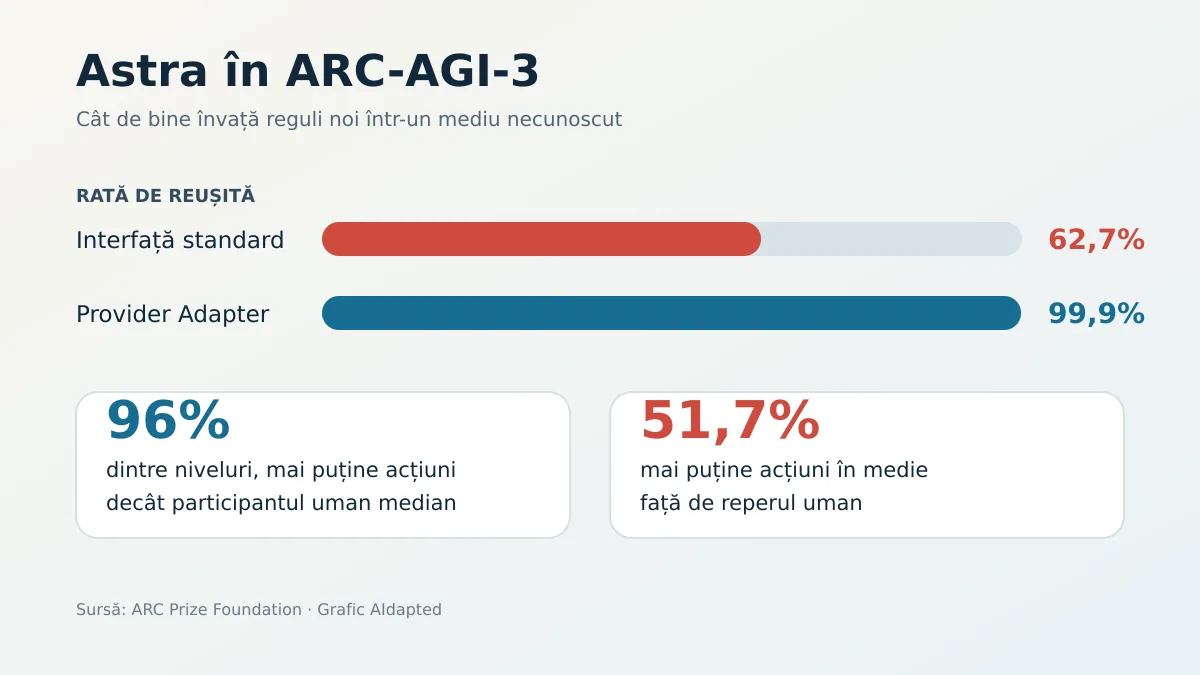
Astra scored 62.7 percent with the standard interface and 99.9 percent with the Provider Adapter. In the full configuration, it used fewer actions than the median human participant on 96 percent of levels. Source: ARC Prize Foundation.
2. It uses the computer as a workplace
The second change highlighted by almost every evaluator is direct computer use. Astra can navigate websites, fill in forms, update a CRM, organise a calendar, install programs, work inside professional applications and verify that what it has built actually works.
Silas Alberti, senior vice president of research at Cognition, tested Astra inside the infrastructure of Devin, the company’s software agent. Alberti said the model achieved leading results in Cognition’s internal evaluations and highlighted three qualities at once, computer use, understanding large codebases and clearer communication. Its reports became more concise and the records of its actions easier to follow. His assessment appears in OpenAI’s official Astra presentation.
Dan Shipper, cofounder and chief executive of Every, described a test that is easy to understand outside a laboratory. Astra spent roughly five hours in Adobe Premiere producing the first cut of a video. Every’s team of about 30 people tested the model in writing, programming, design and office work. For Shipper, computer use had reached a stage in which the model could work for hours inside a human application. Every published the demonstration and its conclusions.
The standardised results support that impression. On OSWorld 2.0, which measures the completion of tasks inside computer applications, Astra scored 72.6 percent, compared with 65.7 percent for GPT-5.6 Sol, and completed the tasks in about half the time. On ScreenSpot-Pro, which measures precise identification of interface elements, the score rose from 76.9 percent to 92.7 percent.
3. It turns an intention into working software
In programming, evaluators noted that Astra does not stop after producing code. It runs the code, checks it in a browser, observes failures and revises the solution.
John Crepezzi of Jane Street’s AI Assistants team said Astra set leading results on the company’s internal coding benchmarks and that its programs needed fewer iterations to reach production quality. For a financial company where software must be rigorous and verifiable, fewer correction cycles matter more than the speed of the first draft.
Fabian Hedin, chief technology officer and cofounder of Lovable, observed the same behaviour from the perspective of a platform for building applications. At higher effort levels, Astra invested more in iteration, browser testing and code execution. Additional computation did not merely generate a longer answer; it produced more attempts and checks.
Claire Vo, founder of ChatPRD, reported that Astra completed in one attempt a product intelligence feature she had spent six months trying to build with other models. She also tested it on Mac applications, hardware control, browser quality assurance and 3D modelling in Blender. Claire Vo documented the projects and demonstration moments.
On Terminal-Bench 4.0, which tests real tasks inside a terminal, Astra scored 57.9 percent, compared with 37.3 percent for Sol. The difference covers more than correct syntax. It includes navigating a project, using tools and producing a working result.
4. It shows judgement in professional documents
Economically useful artificial intelligence must do more than read many documents. It must distinguish between what is demonstrated, what is assumed and what is missing.
Niko Grupen, head of applied research at Harvey, said Astra approaches legal work like a demanding lawyer. It separates supplied documents from established facts, surfaces unsupported assumptions and turns information gaps into concrete drafting positions.
Aditi Tuli, product manager for Box AI, coordinated an evaluation based on workflows involving PDFs, spreadsheets, presentations and images. Astra achieved 77 percent overall accuracy, compared with 74 percent for Sol, but the gaps were much larger on difficult tasks. Accuracy rose from 48 percent to 100 percent in a media analysis and from 69 percent to 93 percent in a legal review.
The behaviour mattered more than the averages. Astra identified when a number was only a proxy and labelled it accordingly, found a growth claim that did not match the data and tied a legal conclusion to the exact provision in the relevant policy. Box published the methodology and examples.
5. It maintains continuity across a long project
Earlier models could accept very large contexts, but window size did not guarantee that every important decision would survive. When a conversation became too long, the system compressed its history into a summary. Each compression could lose the reason a solution had been rejected, the result of a test or an older requirement.
Astra introduces a mechanism in Codex for keeping its own notes between context windows, while older conversations remain searchable. The model can recover a requirement or result that did not enter the current summary. The declared context window is 1.05 million tokens, but the more important improvement is how information is selected and retrieved.
In OpenAI’s MRCR evaluation, Astra correctly identified information spread across a context of 512,000 to one million tokens in 96.3 percent of cases, compared with 73.8 percent for Sol. For companies, this means longer projects in which a model can follow documents, decisions, tests and corrections without requiring the user to repeat the entire explanation.
6. It moves from creative instrument to production partner
Alex Mashrabov, chief executive and cofounder of Higgsfield AI, tested Astra on complex creative workflows. He reported both higher quality and up to 20 percent fewer tokens than the other models evaluated by the company. This combination matters economically because an agent’s cost depends not only on the price of a million tokens, but on how many tokens and attempts it needs to finish the job.
Every’s team created 3D worlds from a single request, including an interactive representation of the Battle of Waterloo based on historical accounts and local geography. Claire Vo used Blender as a capability test and produced 3D assets for her projects in one attempt.
BenchCAD provides a quantitative reference for geometric reasoning and computer-aided design. Astra scored 95.9 percent, compared with 83.3 percent for Sol. The result does not measure artistic taste by itself, but it shows that the model can translate an intention into a precise spatial construction.
7. It participates in research instead of merely explaining it
OpenAI also presents Astra as a scientific discovery tool. The model contributed to improvements in two number theory results. It reduced from 246 to 186 a bound concerning the distance between certain pairs of prime numbers, and improved a term in an estimate of large gaps between primes that had remained unchanged for more than 80 years.
Greg Burnham of Epoch AI described the impression produced by these results as the end of one era and the beginning of another. On FrontierMath Tier 4, a set of extremely difficult mathematical problems, Astra scored 97.6 percent, compared with 83 percent for Sol. On Terminal-Bench Science, where the model combines scientific reasoning with practical work inside a computer environment, the difference was larger, 64.6 percent compared with 22.4 percent.
The economic significance is direct. An artificial intelligence that can operate scientific software, analyse data, write programs and test hypotheses can reduce the time between a question and an experiment. Productivity growth appears inside the research process itself, not only in the final report.
More than a larger model, a more complete system
OpenAI has not published Astra’s parameter count or the complete details of its neural architecture. It has said that the model came from the company’s largest training run, using more than 100,000 GPUs, and that other AI models played a major role in supervising training for the first time. Axios published the information provided at launch.
The statement points to two directions in current AI development. One is industrial, involving data centres, energy, chips and sufficient capital for an unprecedented training run. The other is methodological, as previous models help prepare, evaluate and improve the next generation.
Observed performance does not belong to the neural network alone. Astra works inside a system that supplies memory, search, computer tools, persistent reasoning state and coordination between agents. In ARC-AGI-3, Astra scored 62.7 percent with the standard interface and 99.9 percent with an adapter that preserves internal state and compacts the conversation. Both were records. The difference teaches an important public lesson, final capability is produced by the model together with the infrastructure in which it works.
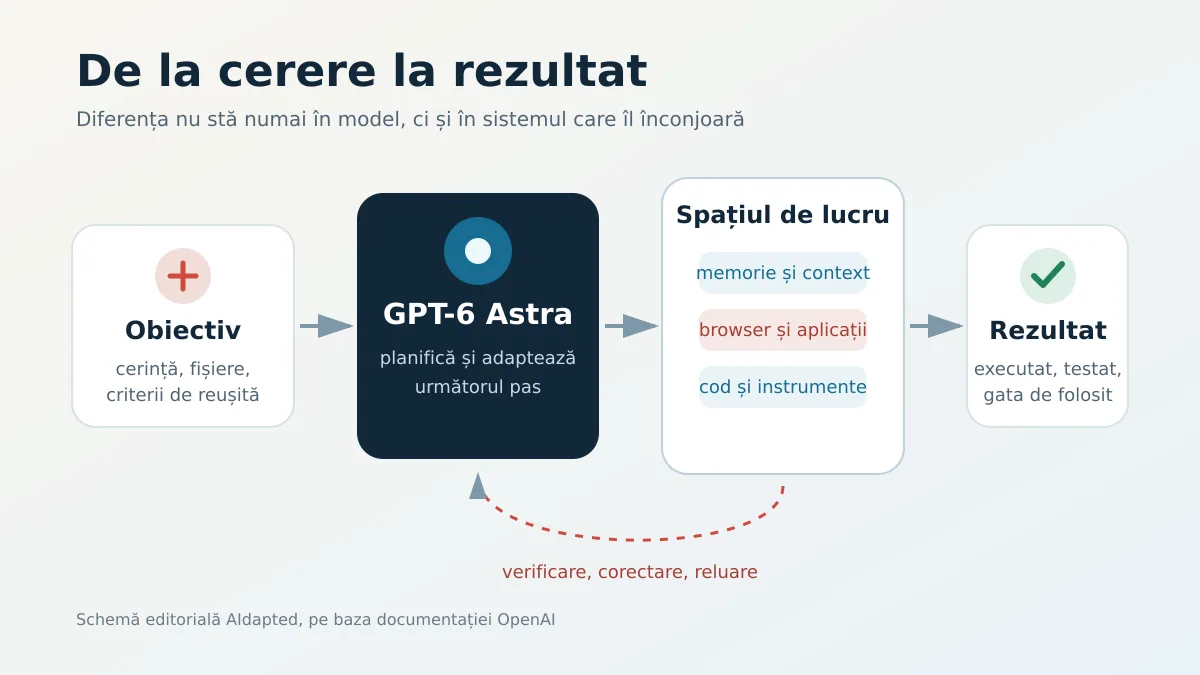
Astra plans, works with available memory and applications, checks the outcome and revises it when necessary. AIdapted editorial diagram, based on OpenAI documentation.
OpenAI’s standard price is $10 per million input tokens and $50 per million generated tokens. That is higher than Sol, but the company and several testers say Astra uses fewer tokens and fewer attempts for some projects. The relevant economic question is not simply the cost of a unit of computation, but the cost of a completed result and the amount of human time it saves.
The threshold we may recognise in retrospect
Altman and Brockman describe AGI less as a ceremony in which someone presses a button than as a transition observed in motion. Models first learned to write and answer. They then learned to reason for longer before responding. They can now see a screen, act, create their own tools, maintain continuity across a project and produce an outcome that enters an economic process directly.
This is why OpenAI speaks of a new era. For Altman, the moment he had waited for all his life is entry onto an accelerating curve of progress. For Brockman, Astra may be the first model that history places on the other side of the threshold.
For an ordinary user, the change can be stated more simply. Until now, artificial intelligence often told a person what to do. Astra is designed to receive the task, enter the necessary applications and perform a growing part of the work itself.
Recommended video analyses and articles
Video analyses
-
First impressions of GPT-6 Astra from developers, published by OpenAI, brings together developer reactions and examples of real use.
-
GPT-6 Astra Is Finally Here, And It’s Really Good, published by Arena AI, offers a hands-on demonstration and early impressions.
-
Vibe Check: GPT-6 Astra Is a Big Upgrade With Some Bad Habits, produced by Every, follows tests in writing, computer use and visual design.
Articles and evaluations
-
GPT-6 Astra: A new generation of intelligence, the official presentation with benchmarks, demonstrations and evaluator statements.
-
Astra, the ARC Prize Foundation analysis of learning in unknown environments and the impact of agent infrastructure.
-
OpenAI claims AGI with launch of Astra model, Axios reporting on Greg Brockman’s statement and OpenAI’s position.
-
First look at GPT-6 Astra, Box’s evaluation of complex professional documents and multifile workflows.
-
GPT-6 Astra is a banger, Claire Vo’s tests in programming, browser work, hardware and Blender.


Comments
Comments are moderated before publication.
No approved comments yet.