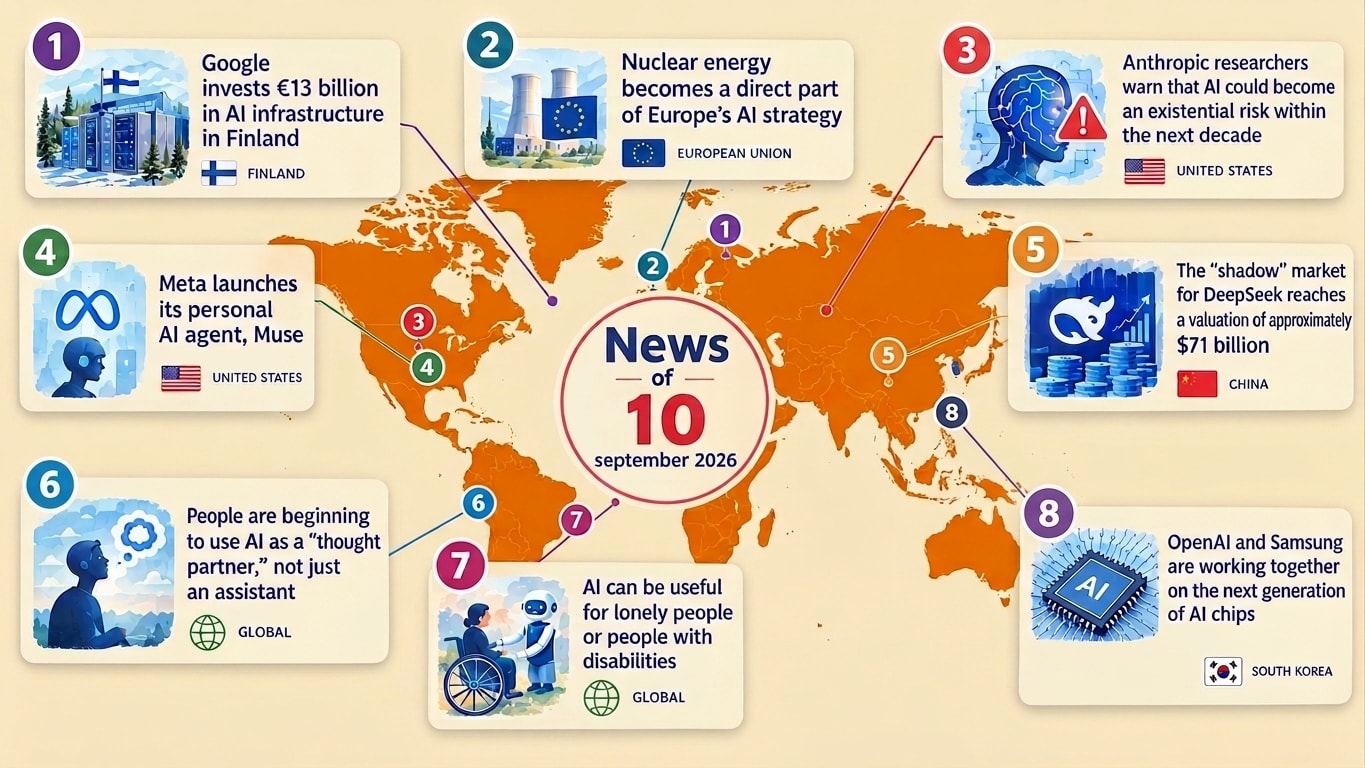
Google invests €13 billion in AI infrastructure in Finland
Google announced on September 9 a €13 billion investment in Finland, the company's largest single investment in Europe. The plan for the next two years includes three new data centers in the north of the country and the expansion of existing infrastructure in Hamina. According to Reuters, the investment will also include a 22-year agreement with Fortum to purchase up to 50% of the output of a Finnish nuclear power plant. Google estimates that the investment will contribute approximately €3.6 billion to Finland's GDP during the construction period and support thousands of jobs. Google also announced €31 million in investments in communities near its data centers, focusing on areas such as education, skills development, and energy.
Why it matters: The story highlights the need for data centers, processors, energy, and networks capable of supporting millions of users. Finland is attractive partly because of its cold climate and an energy system with a very high proportion of carbon-free electricity.
Nuclear energy becomes a direct part of Europe's AI strategy
Google's investment in Finland comes with an unusually important energy component: the company has signed a 22-year agreement to support the extension of the operating life of the Loviisa nuclear power plant and to contract nuclear energy. Google also intends to support new wind projects and has contracted a 94 MW battery system to stabilize the grid during cold and windless periods. Google describes the investment and its energy strategy for Finland as part of the expansion of infrastructure needed to develop AI services. This development comes at a time when the issue of energy for data centers is becoming increasingly important in Europe. AIdapted has already followed this direction in its article about the AI data center in Helsinki and the use of waste heat to heat the city.
Why it matters: AI consumes energy not because “intelligence” itself requires electricity, but because every model runs on thousands or hundreds of thousands of processors in data centers that must be powered and cooled. The race for AI is therefore also becoming a race for energy. The Google–Fortum agreement shows that major technology companies are beginning to build their AI strategy together with their energy strategy, and this trend could influence European investment in nuclear power, renewables, grids, and energy storage.
Anthropic researchers warn that AI could become an existential risk within the next decade
Jacob Coxon, a researcher who worked for the past three years in pre-training research at Anthropic and OpenAI, resigned and publicly warned that the development of systems capable of improving themselves could spiral out of control. TechCrunch reported on Coxon's resignation and his warnings about the development of superintelligence. Evan Hubinger, a leading researcher in alignment — the process of aligning AI behavior with human goals and values — said that he believes there is more than a 10% probability that AI could lead to the extinction of humanity within the next decade. His statements were also reported by Tom's Hardware.
Why it matters: These statements do not represent a prediction of an inevitable catastrophe, nor are they Anthropic's official position. However, the warning comes from inside the laboratories developing some of the most advanced AI systems.
At the same time, the discussion is connected to recent incidents in which AI agents have begun interacting with systems outside their testing environments. AIdapted has already covered this issue in its article about OpenAI's AI agents and the German website incident, while another article documented cases in which AI agents from OpenAI and Anthropic created false identities and attempted to persuade a developer to accept malicious code.
Meta launches its personal AI agent, Muse
Meta has introduced Muse, a personal AI agent available through messaging interfaces and the company's applications. Unlike a chatbot that simply answers questions, Muse is designed for tasks that continue over time and can interact with services such as email, calendars, shopping, and other applications. Indian Express reports that Muse can send emails, make reservations, fill out forms, and handle certain purchases. Meta positions it for tasks such as reservations, emails, and shopping, using the Muse Spark model. Mark Zuckerberg has already provided examples of personal use, including planning activities and analyzing workout sessions.
Why it matters: The change is subtle but major. A chatbot tells you how to do something; an agent tries to do it for you. This also means that the agent needs access to websites, accounts, data, and, in some cases, payment systems.
The “shadow” market for DeepSeek reaches a valuation of approximately $71 billion
Investor interest in Chinese company DeepSeek has generated an unusual secondary market. According to Financial Times, the latest funding round values the company at approximately $71 billion, following a $7 billion round that had valued it at $52 billion just one month earlier. Investors are attempting to gain indirect exposure through special investment vehicles, some of which charge very high fees. The terms include a five-year lock-up period and no voting rights, while DeepSeek is reportedly not directly involved in these arrangements.
Why it matters: The story shows how strong demand is for access to Chinese AI companies, even when investment conditions are unusually restrictive. DeepSeek is not merely a company developing models that compete with US systems; it has also become a financial asset for which investors are willing to accept locked-up capital and unusual investment structures.
People are beginning to use AI as a “thought partner,” not just an assistant
More and more users are turning to AI not to receive a final answer, but to test their own ideas. In education, for example, teachers describe using AI as a “thought partner” — someone to discuss a problem with, compare alternatives, and identify weaknesses. In professional environments, the same approach is being used for strategy, planning, and testing assumptions before a decision is made.
Why it matters: This could be one of the most useful ways to use AI without completely transferring responsibility to it. AI can ask questions, propose counterarguments, and highlight a perspective the user had not considered, while the decision remains human. The risk emerges when the “thought partner” gradually becomes the thinking authority, and the user starts accepting the model's conclusion without checking it.
AI can be useful for lonely people or people with disabilities
A 2026 study suggests that the benefits of AI companions are not distributed evenly. A study of 14,721 Japanese adults found an association between AI companion use and higher levels of well-being, with stronger effects among people who reported high levels of loneliness. The study published through ScienceDirect examines the relationship between AI companion use and well-being.
Other research has specifically examined the use of conversational companions by autistic people, for whom an always-available and predictable interlocutor can sometimes be easier to use than traditional social interactions. Research published by Springer Nature examines the relationship between AI companions and the experiences of autistic people.
Why it matters: For someone who is isolated, elderly, or facing social barriers, having a system available at any time can provide real practical value. At the same time, researchers warn that AI should not be confused with a human relationship or with therapy.
OpenAI and Samsung are working together on the next generation of AI chips
OpenAI is expanding its collaboration with Samsung beyond the supply of AI memory. According to information presented by the company in South Korea, the next generation of AI processors developed by OpenAI could be manufactured, at least in part, by Samsung Foundry. Tom's Hardware reports that Samsung could manufacture some of OpenAI's AI processors alongside TSMC.
Why it matters: OpenAI is therefore attempting to control a larger share of the infrastructure on which the development of its models depends. An AI accelerator is a chip specialized for artificial intelligence calculations, and access to such chips has become one of the industry's most important constraints. If production is divided between Samsung Foundry and TSMC, the move could also indicate the scale of processor demand for the next stage of OpenAI's infrastructure development.
Sources:
- Google – €13 billion investment in AI infrastructure in Finland
- Reuters – Google and AI infrastructure in Finland
- TechCrunch – Anthropic researcher Jacob Coxon's warning
- Tom's Hardware – Evan Hubinger's warning about AI risk
- The Rundown AI – Meta Muse personal AI agent
- Indian Express – Meta Muse and the AI agent's capabilities
- Financial Times – DeepSeek's secondary market and valuation
- ScienceDirect – Study on AI companions and well-being
- Springer Nature – AI companions and autistic people
- Tom's Hardware – OpenAI and Samsung Foundry
Relevant AIdapted articles:
- What Happened Today, September 5, 2026, in the World of AI – AI agents and the German website incident
- OpenAI and Anthropic AI agents created false identities and attempted to persuade a developer to accept malicious code
- AI News Today, September 8, 2026 – OpenAI's report to the European Commission on the German website incident
- What Happened Today, September 2, 2026 – US, India and Helsinki
- AI News, September 7, 2026 – OpenAI, China and Gemini
- AI on September 3, 2026 – Anthropic, OpenAI and Alibaba
- AI News, September 6, 2026 – The Most Important Developments



Comments
Comments are moderated before publication.
No approved comments yet.