The development of an artificial intelligence model begins with the design of its architecture, meaning the way layers of artificial neurons and the connections between them are organized. Within this structure are a very large number of adjustable parameters, the most important of which are known as weights. These are numerical values that determine the influence of each connection on the model’s output. During training, the weights are adjusted repeatedly until the network acquires the ability to recognize patterns, predict continuations and generate responses. The architecture is the general blueprint of the system, while the full set of weights represents the numerical configuration the model acquires through learning. Until now, China’s artificial intelligence industry has allowed relatively broad international access to the weights of some of its high-performing models, especially when compared with major American companies. Open-weight models developed by Chinese companies have been available for researchers, businesses and developers in other countries to download, install and adapt.
From this perspective, a significant part of the Chinese AI ecosystem has been more open than its American counterpart, which is dominated by leading models that are primarily accessible through online services controlled by the companies that created them. That approach now appears to be changing. Regulators led by China’s Ministry of Commerce are consulting major domestic AI and semiconductor companies on ways to prevent advanced technologies and promising start-ups from being easily acquired by Western investors.
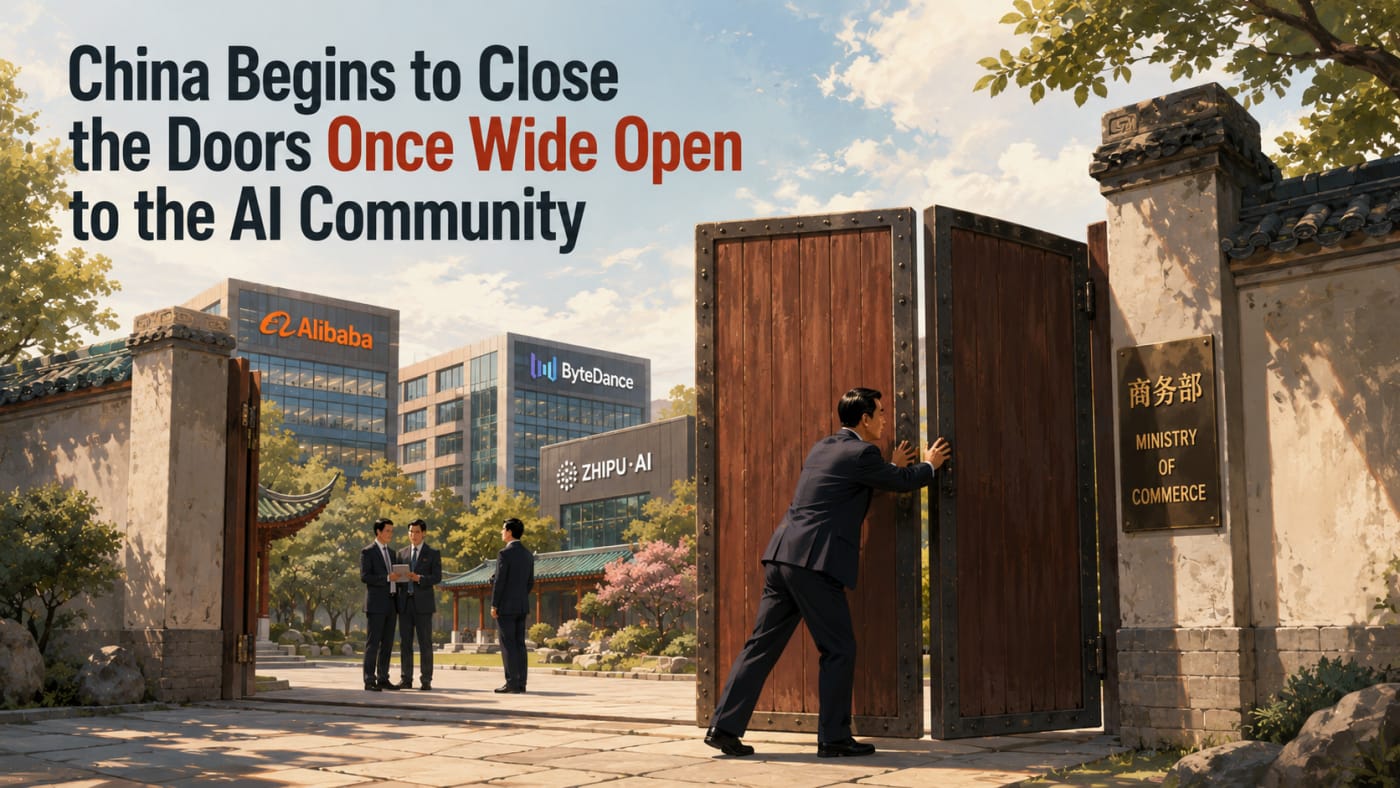
In discussions with companies such as Alibaba, ByteDance and Zhipu, the authorities are considering both restrictions on the overseas transfer of key data used to train AI models and limits on foreign users downloading their model weights. They are also examining measures designed to prevent Western companies from acquiring Chinese firms that develop strategically important AI technologies. Another gateway to the AI revolution is therefore beginning to close. The United States moved earlier to restrict the export of advanced chips and created legal instruments for controlling the transfer of the non-public weights of the most powerful AI models. China now appears ready to introduce its own form of technological protection. The measures under discussion in Beijing could cover an even broader area, because they would apply not only to the finished model, but also to training data, intellectual property and the acquisition of companies that own these technologies.
Should the new restrictions be adopted, the numerical configurations acquired by Chinese models through training may no longer circulate as freely within open-access communities. Foreign users may still be able to use certain Chinese AI services, but without being able to download the model, install it on their own servers or modify it independently. At the same time, access to the underlying technology may no longer be obtained as easily through the acquisition of promising Chinese companies. China is therefore seeking to preserve within its own ecosystem the advantage created by the accumulation, selection and organization of vast quantities of data, by its training methods and by the parameters produced through this process. This is another sign that the AI market is maturing: models are no longer being viewed merely as commercial products or research projects, but as strategic infrastructures comparable to semiconductors, energy systems or advanced military technologies.




Comments
Comments are moderated before publication.
No approved comments yet.