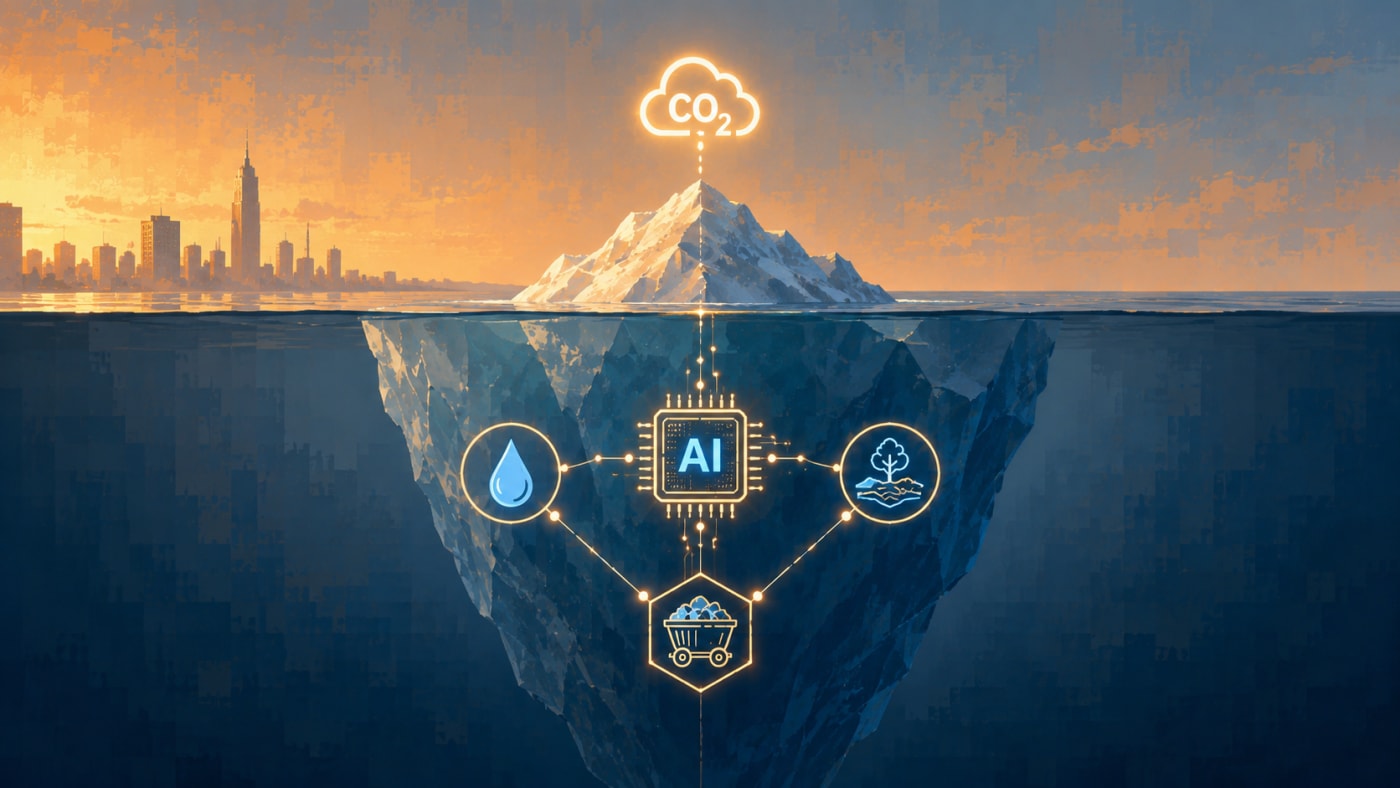
Carbon Emissions Are Only Part of the Story
The report begins with a simple yet far-reaching observation: carbon emissions are not the only environmental cost of artificial intelligence. They are just one of three major impacts, alongside water consumption and land use, and these three indicators do not necessarily move in the same direction.
The researchers show, for example, that replacing coal with bioenergy can reduce the carbon footprint of electricity by as much as 70%, while simultaneously increasing its water footprint by more than thirty-fold and its land footprint by one hundred times.
The practical implication is uncomfortable for the industry: a solution that appears "clean" from a carbon-emissions perspective may, in reality, impose a much heavier burden on local water resources or land use. Assessing AI sustainability through a single metric therefore risks obscuring precisely these kinds of environmental trade-offs.
The numbers are already significant at the global infrastructure level. In 2025, data centers consumed approximately 448 terawatt-hours of electricity. If they were considered a country, they would rank as the world's eleventh-largest electricity consumer, behind France but ahead of Saudi Arabia.
The study's lead researcher notes that energy sources appearing to be the "greenest" in terms of carbon emissions often turn out to be the most demanding when it comes to water or land resources. This serves as a direct warning against the widespread assumption that switching to low-carbon or renewable energy automatically solves the environmental footprint of artificial intelligence.
The reason is straightforward: some low-carbon energy sources, such as nuclear power and hydropower, require substantial amounts of water for cooling or incur significant water losses through evaporation. As a result, reducing carbon emissions does not automatically translate into lower water consumption.
Why Daily Use Matters More Than Training
Public debate about AI's energy consumption has so far focused almost exclusively on the electricity required to train large models. According to estimates cited in the report, training GPT-3 required approximately 1.3 gigawatt-hours of electricity, while GPT-4 is estimated to have required between 50 and 70 gigawatt-hours.
The report argues, however, that this perspective has become outdated. Once a model enters widespread public use, inference—the continuous process of running the model to answer users' queries day after day—accounts for 80% to 90% of AI's total energy consumption.
ChatGPT alone, according to estimates cited in the study, processes roughly 2.5 billion requests per day, translating into approximately 383 gigawatt-hours of electricity per year for this single service.
The differences between AI tasks are equally striking. According to the report, an ordinary conversation with a chatbot consumes roughly 200 times more energy than a simple text-classification task, while generating a single image may require approximately 1,450 times more energy than that baseline. Video generation remains the most resource-intensive application: a short AI-generated video can consume as much electricity as 200,000 basic spam-classification operations, while its associated water footprint may exceed four liters.
Most of the decisions driving this consumption—including which model is used, the default image resolution, or the length of the generated response—remain invisible to users, being determined by the product's default settings.
The Efficiency Paradox
The report also highlights a phenomenon known in economics as the Jevons Paradox, or the rebound effect: making AI models more efficient can actually increase total resource consumption because lower operating costs encourage much wider use.
To counter this effect, the report recommends introducing explicit limits on usage. Otherwise, the authors argue, technological advances risk being entirely offset by rising demand and increased consumption.
Who Bears the Costs and Who Reaps the Benefits?
Perhaps the report's most important conclusion is not about global figures, but about the profoundly unequal way in which the costs and benefits of AI's expansion are distributed.
In Ireland, data centers consumed 21% of all electricity supplied through the national grid in 2023—more than all of the country's urban households combined. Ireland's national grid operator has suspended approvals for new data centers around Dublin until 2028, providing a concrete example of what happens when the expansion of AI infrastructure outpaces a country's ability to plan and expand its energy system.
In Querétaro, Mexico, the rapid growth of computing infrastructure is placing increasing pressure on water resources even during prolonged droughts. In Uruguay, plans for a water-intensive data center coincided in 2023 with a severe drought that depleted Montevideo's freshwater reserves, leaving tap water unsafe to drink.
An example that emerged only days after the publication of the UN report illustrates just how timely this issue remains. On 21 July 2026, Water UK, the organization representing water companies across Great Britain and Northern Ireland, submitted an official document to British lawmakers accusing the government of completely excluding data centers from its projections of future water demand, despite the fact that they consume significant amounts of water both directly, through cooling systems, and indirectly, through their substantial electricity requirements.
According to Water UK, the government's plans for a massive expansion of AI infrastructure contain no assessment of the impact on water resources, even though a separate report by the House of Lords, published in May, had already warned that England could face a daily water deficit of five billion liters by 2055 if current trends continue.
The British case effectively confirms, only weeks after the UN report was released, exactly the pattern identified by its researchers: the real pressure exerted by the expansion of artificial intelligence on water resources remains largely absent from the official planning of many governments eager to attract investment in AI infrastructure.
The concentration of specialized computing capacity—90% of which is located in just two countries, the United States and China—should not be viewed merely as an economic imbalance, but as an issue of environmental justice. Countries excluded from this technological race still bear a significant share of its costs through the extraction of critical minerals required for AI hardware and the management of the resulting electronic waste, while the strategic benefits generated by this infrastructure are captured elsewhere.
Globally, according to the report's estimates, AI infrastructure could generate up to 2.5 million tonnes of electronic waste annually by 2030.
What Does the UN Report Actually Propose?
When presenting the report, the director of the institute that led the research emphasized that the study is not an argument against artificial intelligence—a technological transformation he considers capable of improving the lives of billions of people. Rather, it is a call for AI to be developed and deployed responsibly, ensuring that the communities supplying the critical minerals required for these technologies, as well as those hosting the infrastructure and managing its waste, also become genuine beneficiaries of the transformation they help make possible.
The report proposes a governance framework built around six core principles: transparency, efficiency by design, equity and environmental justice, life-cycle responsibility, international cooperation, and sustainable use. It also offers tailored recommendations for governments, AI developers, users, data center operators, investors, and international institutions, ranging from standardized environmental impact reporting to the early involvement of local communities in decisions regarding the location of new data centers.
Whether this governance framework—currently only a set of recommendations on paper—will translate into the real-world decisions of the companies developing and operating these models remains to be seen, particularly at a time when competitive pressures within the AI industry continue to drive the opposite trend: increasingly larger models, used ever more frequently, while remaining ever less transparent about the resources consumed by every processed request.
The report's most important conclusion is that there is no single metric capable of capturing the environmental impact of artificial intelligence. A solution that reduces carbon emissions may simultaneously increase the consumption of water, land, or raw materials, meaning that optimizing one environmental variable can simply shift significant costs onto others.
The UN report does not fundamentally change what we know about AI's environmental footprint; it changes how that footprint should be measured. In other words, the criteria by which we evaluate the sustainability of AI are themselves beginning to change.
The report also raises an important issue of transparency. If AI's true environmental impact cannot be described through a single metric, companies are likely to face growing pressure to disclose far more detailed information about the resources their models consume.



Comments
Comments are moderated before publication.
No approved comments yet.